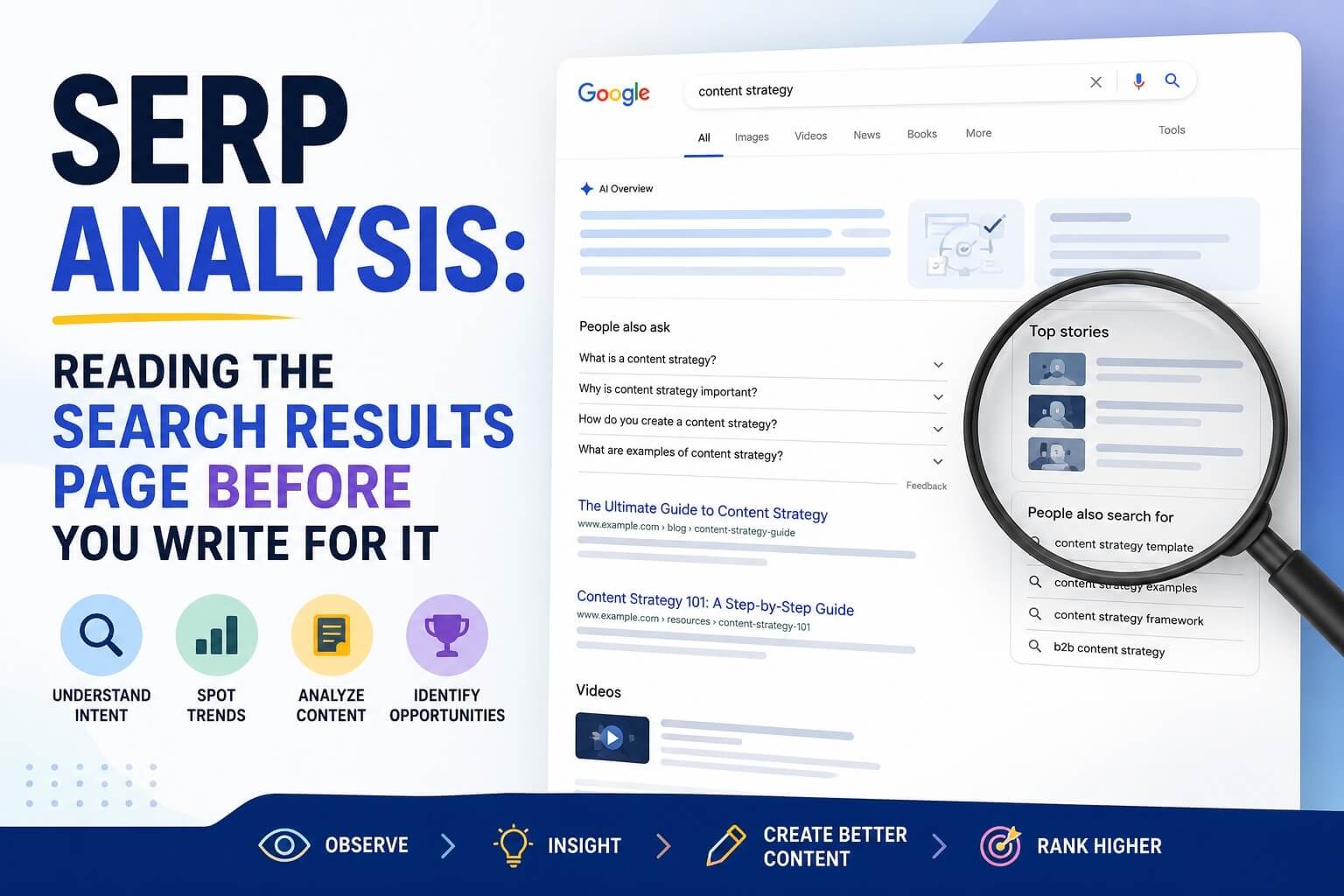
Google has already told you how to rank for a keyword. The answer is sitting on the search results page: the pages it chose to reward, the format it favors, the intent it decided the query represents, and the features it surfaces above the organic list. Most content gets written without anyone stopping to read that answer. The result is a page built on assumptions about what should rank, rather than evidence about what does.
Herenkou’s SERP Analysis is the step that reads the answer first. It takes a deep look at the search results page for a target keyword, examining search intent, SERP features, competitor content strategy, and what ranking approach would actually move the needle. Before you commit to an angle, a format, or a word count, you know what the search results page is rewarding and what it would take to earn a place on it.
Here’s what SERP analysis examines, why it belongs at the front of any serious content effort, and why running it through Herenkou beats eyeballing the results page yourself.
Why the Search Results Page Is the Real Brief
Every keyword has a search results page, and that page is a direct signal of what Google believes satisfies the query. The pages ranking in the top positions aren’t there by accident. They represent Google’s current judgment about what content best answers the search, which format suits it, and what depth it demands. Ignoring that judgment and writing what you assume should rank is how good content ends up on page three.
Reading the SERP flips the process. Instead of guessing what the query wants and hoping you’re right, you study what’s already winning and build something that fits, and then surpasses, that pattern. It’s the difference between writing into a void and writing into a well-understood competitive landscape.
This matters because the SERP for a keyword can defy expectations. A term you assumed wanted a long guide might be dominated by short, punchy comparison pages. A keyword you thought was informational might return mostly product pages, revealing commercial intent you’d have missed. The features on the page, a featured snippet, a video carousel, a local pack, an AI overview, tell you how Google is choosing to answer, which shapes how you should structure your content to compete. None of this is visible unless you look, and looking carefully is what SERP analysis does.
What Herenkou's SERP Analysis Examines
The SERP Analysis studies the search results page for a target keyword across four connected dimensions.
Search Intent
Search intent is the reason behind the query, what the searcher actually wants, and it’s the foundation everything else rests on. The analysis reads the SERP to determine whether the intent is informational (the searcher wants to learn), commercial (they’re researching before a decision), transactional (they’re ready to act), or navigational (they’re looking for a specific destination). The ranking pages reveal this clearly: a results page full of how-to guides signals informational intent, while one full of product and pricing pages signals transactional intent. Getting intent right is non-negotiable, because content that mismatches the intent Google has assigned to a keyword will not rank, however well it’s written.
SERP Features
Beyond the standard list of blue links, search results pages now include a range of features: featured snippets, People Also Ask boxes, video carousels, image packs, local packs, knowledge panels, and increasingly AI-generated overviews. The analysis examines which features appear for the target keyword, because each one is both an opportunity and a constraint. A featured snippet is a chance to capture position zero if you structure content to win it. A video carousel might signal that video content has an edge for this term. An AI overview changes how much organic attention is left and what kind of content gets cited. Knowing which features are in play tells you where the real estate and the opportunities are.
Competitor Content Strategy
The analysis studies what the ranking competitors are actually doing: the angle they take, the depth they go to, how they structure their pages, and what they emphasize. This is competitive intelligence drawn from the pages Google has already validated by ranking them. Rather than guessing at a winning approach, you can see the common threads among the pages that succeed, and just as importantly, spot where they converge so predictably that a different approach could stand out. Their collective strategy is a map of what currently works for this keyword.
What Would Actually Move the Needle
The three dimensions above converge on the question that matters: what ranking approach would actually move the needle for this keyword. Based on the intent, the features, and the competitor landscape, the analysis points toward the content strategy most likely to compete, the right format, the right depth, the angle that fills a gap, and the SERP features worth targeting. This is where SERP analysis stops being observation and becomes direction. It doesn’t just describe the results page; it tells you how to earn a place on it.
Where SERP Analysis Fits in the Workflow
SERP analysis belongs at the very front of content creation, before writing and often alongside keyword research. Keyword research tells you which term to target and whether it’s worth pursuing; SERP analysis tells you what winning that term actually requires. Together they form the strategic foundation that everything downstream, the outline, the draft, the optimization, is built on.
Skipping this step is where a lot of content effort is quietly wasted. A team can research a keyword, write a genuinely good article, optimize it carefully, and still fail to rank because the piece didn’t match what the SERP was rewarding, wrong intent, wrong format, no attempt at the features in play. SERP analysis prevents that failure at the source, by ensuring the content is aimed at the target Google has actually set rather than the one you assumed.
Why Using Herenkou Is Better for SERP Analysis
Anyone can open a search results page and glance at it. Doing it thoroughly and systematically, extracting intent, cataloguing features, decoding competitor strategy, and translating all of it into a clear ranking approach, is a different matter, and it’s where a manual look tends to fall short. Herenkou makes the analysis rigorous.
It reads the SERP completely. A quick glance catches the obvious, the top result, maybe the featured snippet, and misses the rest. A structured analysis accounts for intent, every relevant feature, and the full competitive pattern, so nothing that affects your ranking approach goes unnoticed.
It turns observation into direction. The value isn’t just describing what’s on the results page; it’s telling you what to do about it. Herenkou’s analysis converges on a recommended ranking approach, so you leave with a plan, not just a description.
It’s consistent across keywords. Applying the same analytical framework to every target keyword lets you compare opportunities on equal terms and make sound decisions about where to invest, which matters when you’re choosing among many possible topics.
It connects to everything downstream. SERP analysis in Herenkou isn’t an isolated lookup; it feeds the research and writing that follow, so the intent, features, and competitive insights you uncover actually shape the content you produce rather than sitting in a separate report.
The broader benefit is that you stop writing blind. Content built on a real reading of the search results page is aimed at a target you can see, which is a fundamentally better position than writing something you hope will rank and finding out only after publishing whether it fit. That shift, from assumption to evidence, is what makes the difference between content that competes and content that merely exists.
A SERP Analysis Checklist
The feature automates this, but here’s the checklist it effectively runs, useful for interpreting its output or reading a SERP yourself:
- What intent do the ranking pages reveal, informational, commercial, transactional, or navigational?
- Does that intent match the content you intended to create?
- Which SERP features appear, featured snippet, People Also Ask, video, images, local pack, AI overview?
- Which of those features are realistic to target with your content?
- What format dominates the top results, guides, listicles, product pages, comparisons?
- How deep and comprehensive are the ranking pages?
- What angle do competitors share, and where is there room to differentiate?
- Given all of the above, what specific approach gives this page the best chance to rank?
Frequently Asked Questions
These answers use the question-first, answer-first structure that AI answer engines and featured snippets tend to extract.
What does Herenkou's SERP Analysis do?
Herenkou’s SERP Analysis takes a deep look at the search results page for a target keyword. It examines search intent, SERP features, competitor content strategy, and what ranking approach would actually move the needle. The result is an evidence-based understanding of what the search results page is rewarding and what your content needs to do to earn a place on it, before you start writing.
What is SERP analysis?
SERP analysis is the process of studying the search engine results page for a target keyword to understand what it takes to rank. It examines the intent behind the query, the features present on the page (such as featured snippets and AI overviews), and the strategy of the pages already ranking. The goal is to base your content approach on evidence of what already succeeds for the keyword rather than on assumptions.
How do I find the search intent behind a keyword?
Look at the pages currently ranking for it. If the results are dominated by how-to guides and explainers, the intent is informational; if they’re product or pricing pages, it’s transactional; if they’re comparison and review pages, it’s commercial investigation. The search results page reflects the engine’s judgment about what the query wants, so reading the top results is the most reliable way to identify intent before creating content.
What are SERP features, and why do they matter?
SERP features are the elements on a search results page beyond the standard list of links, including featured snippets, People Also Ask boxes, video and image carousels, local packs, knowledge panels, and AI-generated overviews. They matter because each shapes how much attention organic results receive and what kind of content gets surfaced. Knowing which features appear for a keyword tells you which opportunities to target and how to structure content to compete for them.
What is GEO and AEO, and how does SERP analysis support them?
GEO (generative engine optimization) is optimizing content to be cited by AI engines like ChatGPT, Perplexity, Gemini, and Google’s AI Overviews. AEO (answer engine optimization) is optimizing content to be extracted as direct answers in snippets and AI answer boxes. SERP analysis supports both directly, because AI overviews and featured snippets are now SERP features themselves. Analyzing which of these appear for a keyword, and what content they draw from, tells you exactly how to structure a page to be surfaced and cited by both traditional and AI-driven search.
How do AI Overviews change SERP analysis?
AI Overviews add a generative answer at the top of many results pages, which changes both where attention goes and what kind of content gets cited. Analyzing a SERP now means noting whether an AI Overview appears, what sources it draws from, and how much space remains for organic results. Content aiming to be cited in these overviews needs the clarity, structure, and credible sourcing that generative engines favor, so identifying their presence during SERP analysis directly informs a GEO strategy.
Is SERP analysis different from keyword research?
Yes, though they work together. Keyword research identifies which terms to target and estimates their volume and difficulty. SERP analysis studies the actual results page for a chosen keyword to reveal intent, features, and the competitive approach required to rank. In short, keyword research tells you which keyword to pursue, and SERP analysis tells you what winning that keyword actually takes. Both belong at the start of content creation.
Why do some well-written articles still fail to rank?
The most common reason is a mismatch between the content and what the search results page rewards, wrong search intent, wrong format, or no attempt at the SERP features in play. An article can be well-researched and well-written and still fail if it doesn’t fit the pattern Google has established for the keyword. SERP analysis prevents this by revealing that pattern before writing, so the content is aimed at the target the results page has actually set.
The search results page is the clearest brief you’ll ever get for a keyword, and it’s free to read if you know how to read it. Building content on that evidence, rather than on assumptions about what should rank, is what separates pages that compete from pages that never had a chance.
See how Herenkou reads the search results page for any keyword with its SERP Analysis, explore how the full workflow fits together, or compare plans and pricing to find the tier that matches your needs.