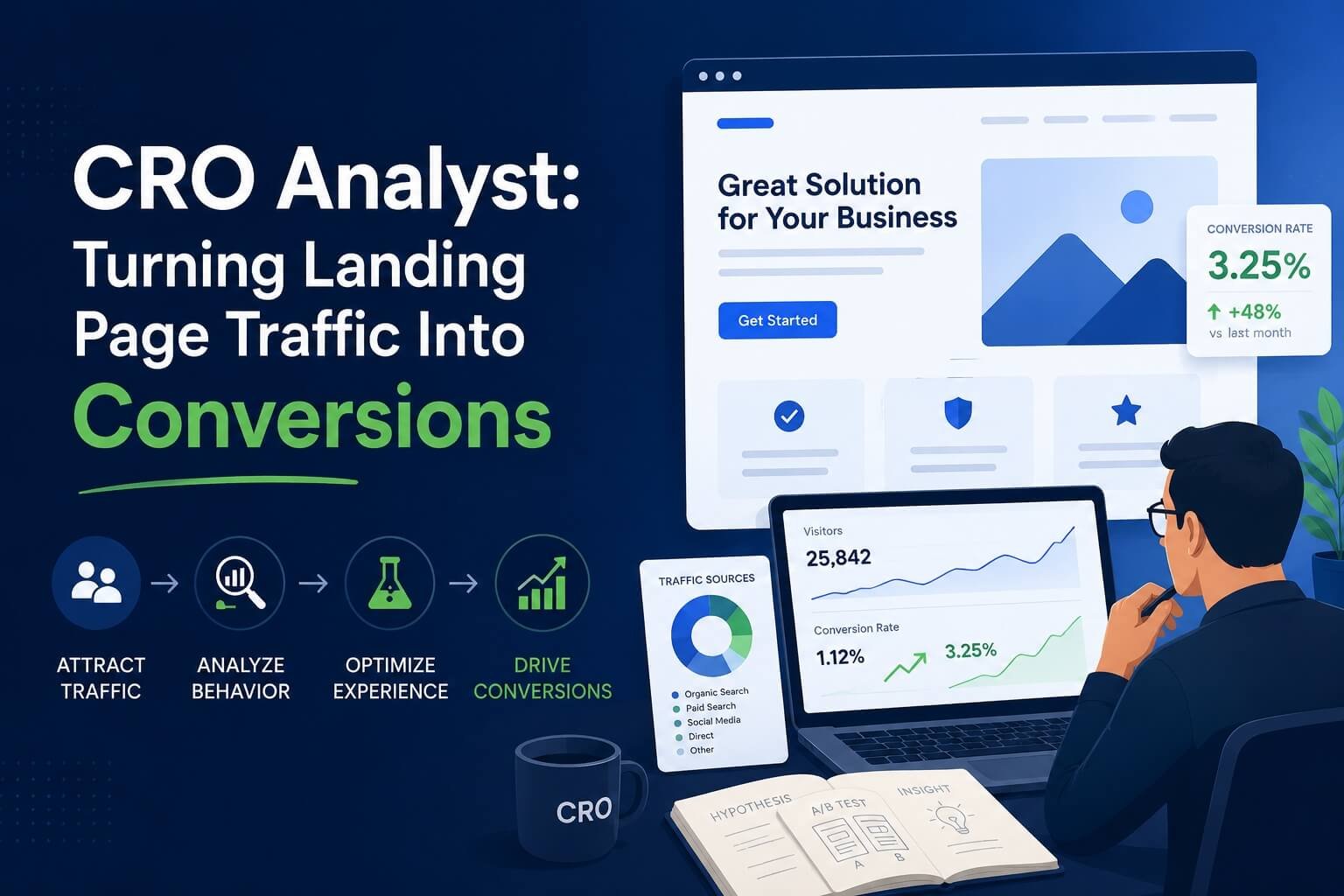
Ranking a landing page is only half the job. You can win the keyword, earn the click, and bring qualified visitors to the page, and still watch most of them leave without doing the one thing you built the page for. Traffic that doesn’t convert is expensive attention with nothing to show for it. The gap between a page that gets visits and a page that gets results is conversion rate optimization, and it’s the part of the funnel most content workflows never touch.
Herenkou’s CRO Analyst closes that gap for landing pages specifically. It runs a conversion rate optimization analysis that evaluates how well the page turns visitors into action: above-the-fold effectiveness, the quality and distribution of calls to action, the presence of trust signals, friction points in the user journey, and overall page structure. Instead of guessing why a page underperforms, you get a structured read on what’s helping conversion and what’s quietly killing it.
Here’s what the CRO Analyst examines, why conversion optimization belongs alongside your SEO work, and why running it through Herenkou beats a manual review.
Why CRO Matters as Much as Ranking
SEO and CRO answer two different questions. SEO asks, “How do we get people to the page?” CRO asks, “Once they’re here, how do we get them to act?” A content strategy that nails the first and ignores the second is pouring water into a leaky bucket. More traffic just means more visitors slipping through the holes.
The economics make the case plainly. Doubling your traffic is hard, slow, and often expensive. Doubling your conversion rate on the traffic you already have can produce the same result in revenue, without earning a single extra visit. A landing page converting at 2% that improves to 4% has effectively doubled its output from the identical audience. That’s why conversion optimization is frequently the highest-leverage work available to a page that already ranks.
Landing pages are where this matters most. Unlike a blog post meant to inform, a landing page exists to drive a specific action: a signup, a demo request, a purchase, a lead. Every element on it either moves the visitor toward that action or gets in the way. CRO analysis is how you find out which is which.
What the CRO Analyst Evaluates
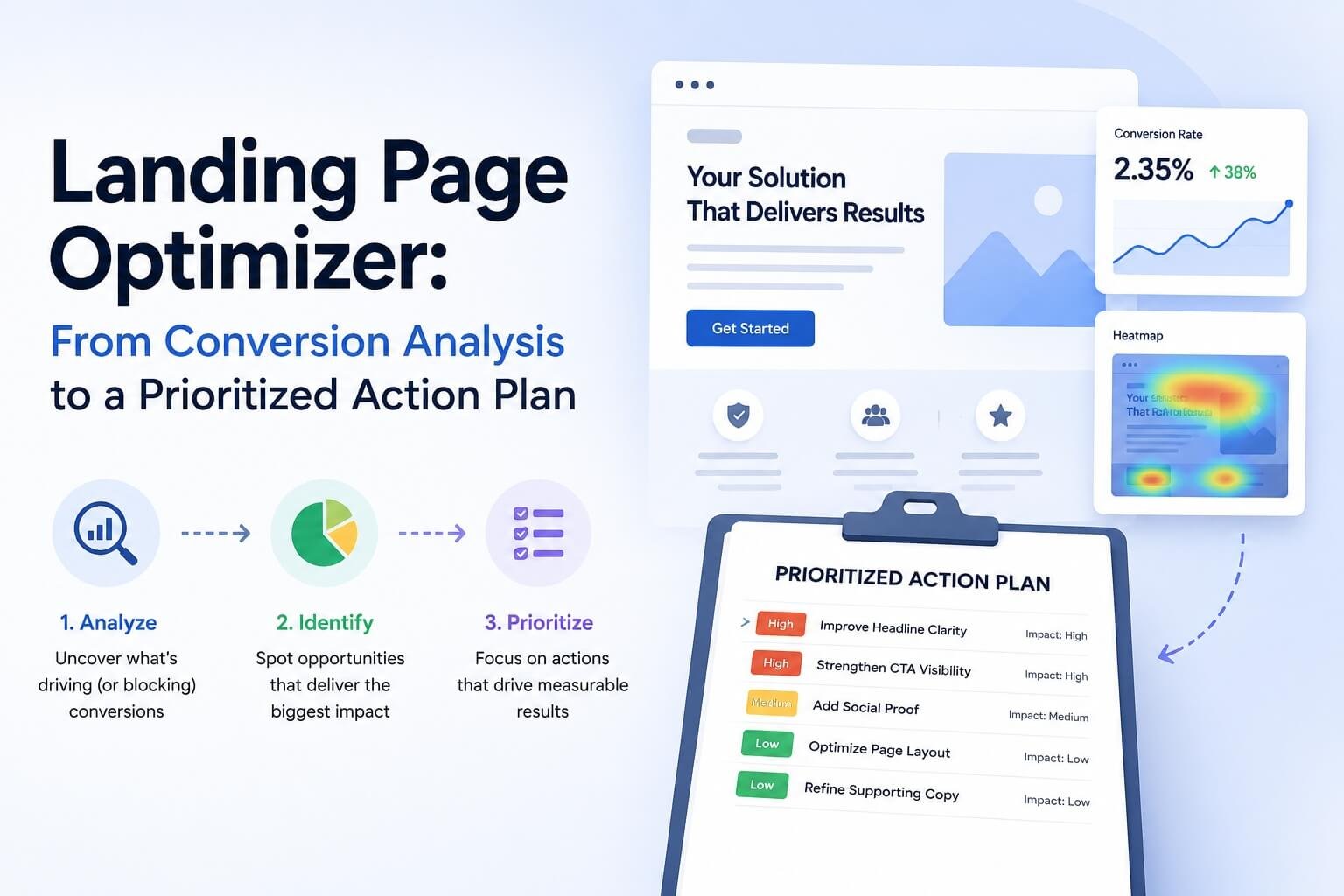
The CRO Analyst reviews a landing page across five dimensions that most directly shape whether visitors convert.
Above-the-Fold Effectiveness
The first screen a visitor sees, before any scrolling, does the heaviest lifting on any landing page. In those first few seconds a visitor decides whether to stay or leave. The CRO Analyst evaluates above-the-fold effectiveness: whether the headline communicates the value clearly, whether the primary action is immediately visible, and whether the opening makes a strong enough case to earn the scroll. A weak fold means most visitors never see the rest of the page, no matter how good it is.
Quality and Distribution of Calls to Action
A call to action is the moment you ask the visitor to act, and both its wording and its placement matter. The analysis assesses the quality and distribution of CTAs: whether the button copy is clear and compelling, whether the primary action stands out, and whether calls to action appear at the right points throughout the page rather than only at the top or buried at the bottom. A page with one weak CTA leaves conversions on the table; a page with well-placed, well-written CTAs meets the visitor whenever they’re ready to act.
Presence of Trust Signals
People don’t convert on pages they don’t trust. Trust signals are the elements that build the credibility a visitor needs before handing over an email, a payment, or a commitment: testimonials, reviews, client logos, security badges, guarantees, social proof. The CRO Analyst checks whether these signals are present and positioned where they can do the most good. Their absence is one of the most common and most fixable reasons a well-designed page still fails to convert.
Friction Points in the User Journey
Friction is anything that makes acting harder than it needs to be: a form asking for too many fields, a confusing next step, an unclear path from interest to action, a distraction pulling attention away from the goal. The analysis identifies friction points in the user journey, the specific spots where visitors are likely to hesitate or drop off. Removing friction is often the fastest conversion win available, because it doesn’t require persuading anyone of anything new, only clearing the obstacles between intent and action.
Overall Page Structure
Finally, the CRO Analyst evaluates overall page structure: whether the page flows in a logical order that builds toward the conversion, whether information appears when the visitor needs it, and whether the layout guides attention rather than scattering it. A page can have a strong headline, good CTAs, and solid trust signals and still underperform if they’re arranged in a way that doesn’t lead the visitor naturally toward acting.
From Analysis to Higher Conversions
The point of the analysis is action. By evaluating these five dimensions together, the CRO Analyst produces a clear picture of where a landing page is strong and where it’s losing conversions, so you know exactly what to change. Rather than redesigning a page on instinct and hoping the numbers improve, you get specific, evidence-based direction on the elements most likely to move your conversion rate.
That focus matters because CRO is easy to approach superficially. Swapping a button color or rewriting a headline on a whim might help, might hurt, or might do nothing. A structured analysis across the dimensions that actually drive conversion turns optimization from guesswork into a targeted plan.
Why Using Herenkou Is Better for Landing Pages
You can review a landing page for conversion issues yourself, and an experienced marketer will catch some of them. The difficulty is doing it comprehensively and consistently, without letting personal blind spots or a single pet theory dominate the review. Herenkou makes the analysis systematic.
It’s comprehensive by design. The CRO Analyst evaluates all five dimensions every time, so you don’t fixate on the CTA and overlook the missing trust signals, or polish the headline and ignore the friction in your form. Full coverage catches the issues a partial review misses.
It’s objective. A tool applies the same conversion criteria to every page, free of the assumptions and attachments that color a manual review of your own work. That objectivity surfaces problems you’re too close to the page to see.
It’s consistent across pages. Running the same analysis on every landing page lets you compare them on equal terms and apply the same standards library-wide, which is essential when you’re optimizing more than one page at a time.
It connects traffic to results. Herenkou already helps you rank and write the content that draws visitors. The CRO Analyst extends that work to what happens after they arrive, closing the loop between attracting traffic and converting it, within one workflow rather than across disconnected tools.
The larger benefit is strategic completeness. Optimizing only for rankings means fighting hard to bring visitors to a page that then lets them slip away. Pairing SEO with conversion analysis means the traffic you work to earn actually produces outcomes. That pairing, getting people to the page and getting them to act, is what turns content from a cost into a return.
A Landing Page CRO Checklist
The CRO Analyst automates this, but here’s the checklist it effectively runs, useful for reviewing its output or spot-checking a page yourself:
- Does the above-the-fold area communicate the value and show the primary action clearly?
- Is the main call to action prominent, specific, and compelling?
- Do CTAs appear at multiple logical points, not just once?
- Are trust signals (testimonials, reviews, logos, guarantees) present and well-placed?
- Is the form as short as it can be, asking only for what’s necessary?
- Is the path from interest to action clear, with no confusing steps?
- Are there distractions pulling attention away from the conversion goal?
- Does the page flow in a logical order that builds toward the action?
- Is the value proposition clear enough that a first-time visitor gets it immediately?
Frequently Asked Questions
These answers use the question-first, answer-first structure that AI answer engines and featured snippets tend to extract.
What does Herenkou's CRO Analyst do?
Herenkou’s CRO Analyst runs a conversion rate optimization analysis on landing pages. It evaluates above-the-fold effectiveness, the quality and distribution of calls to action, the presence of trust signals, friction points in the user journey, and overall page structure. The result is a clear, structured read on where a landing page is winning conversions and where it’s losing them, so you know exactly what to improve.
What is conversion rate optimization (CRO)?
Conversion rate optimization is the practice of improving the percentage of visitors who complete a desired action on a page, such as signing up, requesting a demo, or making a purchase. It focuses on getting more results from existing traffic rather than acquiring more traffic. CRO typically examines page elements like headlines, calls to action, trust signals, forms, and layout to remove barriers to conversion.
How is CRO different from SEO?
SEO focuses on getting visitors to a page by improving its visibility in search results. CRO focuses on what happens once they arrive, improving the share of visitors who take the desired action. They’re complementary: SEO drives traffic, CRO converts it. Optimizing only for SEO brings visitors to a page that may not convert them, while combining both ensures the traffic you earn produces actual results.
What are the most important elements of a high-converting landing page?
The highest-impact elements are a clear above-the-fold value proposition and visible primary action, strong and well-placed calls to action, credible trust signals like testimonials and reviews, minimal friction in forms and the path to action, and a logical page structure that guides visitors toward converting. Weakness in any one of these can suppress conversions even when the rest of the page is strong.
What are trust signals, and why do they matter for conversions?
Trust signals are elements that build a visitor’s confidence in a brand or offer, including testimonials, customer reviews, client logos, security badges, guarantees, and other forms of social proof. They matter because people are reluctant to act, especially to pay or share personal information, on pages they don’t trust. Adding credible, well-placed trust signals is one of the most common and effective ways to lift a landing page’s conversion rate.
What is GEO and AEO, and how do they relate to landing page conversions?
GEO (generative engine optimization) is optimizing content to be cited by AI engines like ChatGPT, Perplexity, Gemini, and Google’s AI Overviews. AEO (answer engine optimization) is optimizing content to be extracted as direct answers in snippets and AI answer boxes. They increasingly influence how visitors discover a landing page, since more traffic now arrives via AI-driven search. That makes conversion optimization more important, not less: as AI sends better-qualified visitors to your page, a well-optimized page ensures that traffic actually converts.
Does landing page structure affect SEO as well as conversions?
Yes. A clear, logical page structure benefits both. For conversions, it guides visitors toward the desired action; for SEO, clean structure, clear headings, and good user experience support rankings and help both search and AI systems understand the page. Well-structured pages also tend to keep visitors engaged longer, and positive engagement signals can reinforce search performance, so structure serves ranking and conversion goals at once.
How often should I run a CRO analysis on my landing pages?
Analyze a landing page when it launches, whenever its conversion rate drops, and periodically as part of ongoing optimization, particularly on your highest-value pages. Because visitor expectations, competitors, and traffic sources change over time, a page that converted well a year ago may have room to improve now. Treating CRO as a recurring review rather than a one-time task keeps your most important pages performing.
Traffic is only valuable if it converts. A landing page that ranks well but lets visitors slip away is leaving its best results unclaimed, and the fix is usually cheaper and faster than earning more traffic. A structured conversion analysis shows you exactly where those results are going and how to recover them.
See how Herenkou analyzes landing pages for conversion with its CRO Analyst, explore how the full workflow fits together, or compare plans and pricing to find the tier that matches your needs.