Analyze Existing Content
The draft is written. The keywords are in, the structure looks right, the links are placed. You’re ready to publish — or you think you are.
This is the exact moment most SEO mistakes slip through: a meta description that got left blank, a keyword that’s in the body but missing from the H1, an internal link that could have been stronger. Small things, individually. Collectively, the difference between a page that performs and one that quietly underdelivers.
The fix is a final optimization pass — a last, systematic check before anything goes live.
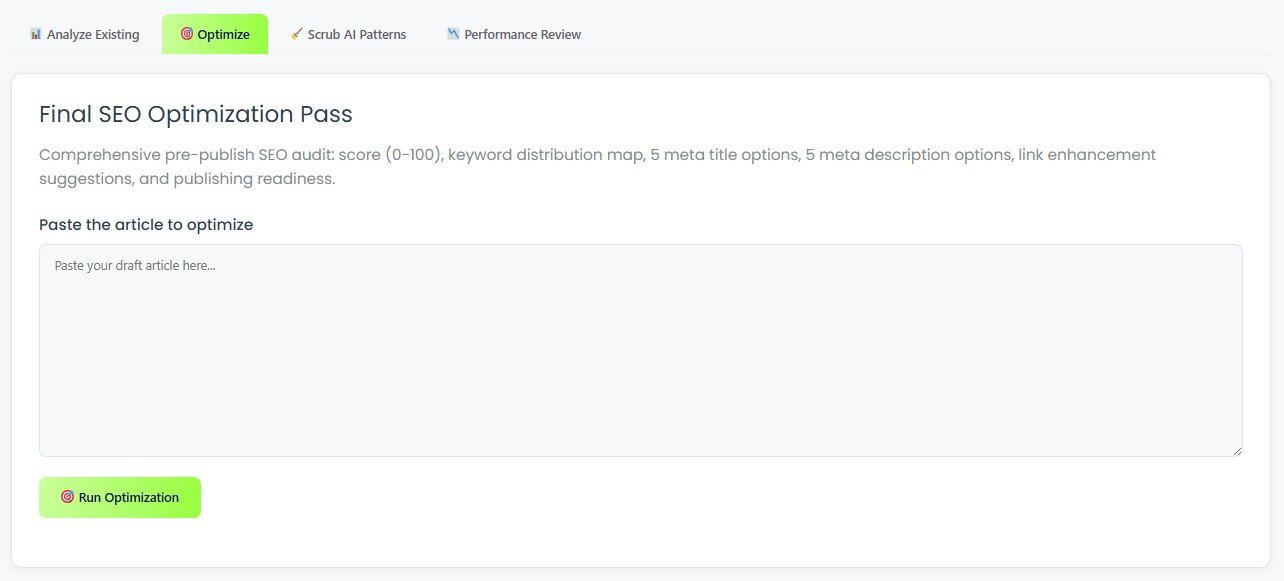
Herenkou’s Final Optimization Pass does exactly that: it delivers an SEO score from 0 to 100, a prioritized list of fixes, a set of quick wins, multiple meta element options, link enhancement suggestions, and an overall publishing-readiness assessment. It’s the gate that catches what a manual final read misses, so you publish with confidence instead of hoping you didn’t overlook anything.
Here’s what the feature checks, how it differs from analyzing existing content, and why running your final SEO pass through Herenkou beats eyeballing a checklist.
Why a Final Pass Matters
Writing and optimizing happen in stages, and each stage focuses on its own concerns — research on the keyword, drafting on the content, editing on the prose. What no single stage guarantees is that the finished piece, as a whole, is fully publish-ready. Details fall through the cracks between steps, not within them.
A dedicated final pass exists to catch those cracks. It looks at the completed article the way a search engine will — as one finished artifact — and verifies that every on-page element is actually in place and actually optimized. It’s the difference between “I think this is ready” and “I’ve confirmed this is ready.”
That confirmation is worth more than it sounds. A missing meta description won’t stop a page from publishing, but it hands Google a worse snippet and costs you clicks. A keyword absent from the H1 won’t break the page, but it weakens the single strongest on-page signal you have. These aren’t dramatic errors — they’re quiet ones, and quiet errors are exactly what a final systematic check is designed to surface before they cost you anything.
What the Final Optimization Pass Delivers
An SEO Score (0–100)
A Prioritized List of Fixes
Quick Wins
Multiple Meta Element Options
Link Enhancement Suggestions
An Overall Publishing-Readiness Assessment
Finally, the pass gives an overall publishing-readiness assessment — the plain verdict on whether the piece is ready to go live, or whether it needs another round first. This is the decision the whole pass builds toward: a clear go / not-yet call, backed by the score and the fix list, so hitting publish is an informed choice rather than a leap of faith.
How the Final Pass Differs From Analyzing Existing Content
Analyzing existing content is diagnostic triage of published pages. You point it at a live post that may have slipped or gone stale, and it tells you whether that page is worth rewriting and at what scope. It’s about deciding what to do with content that already exists in the wild.
The Final Optimization Pass is the last quality gate on a finished draft that hasn’t been published yet. It’s not asking “should we rewrite this?” — it’s asking “is this ready to go live right now, and what should we fix in the final minutes before we publish?”
One looks backward at what’s already out there to prioritize maintenance; the other looks forward at what’s about to ship to guarantee it ships in good shape. Together they cover both ends: nothing goes out unpolished, and nothing already out stays neglected.
Why Using Herenkou Is Better for SEO Content
A final SEO check done by hand is only as good as the person’s memory and attention on that particular day. Miss a line on your mental checklist and the error ships. Herenkou is better for SEO content because it makes that final gate systematic, consistent, and actionable.
It's consistent every time.
It prioritizes instead of just listing.
It ends in a verdict.
It gives you options where options help.
Multiple meta variants and specific link suggestions mean the pass doesn’t just flag gaps — it offers ready-to-use ways to close them.
It's the last stage of one connected pipeline.
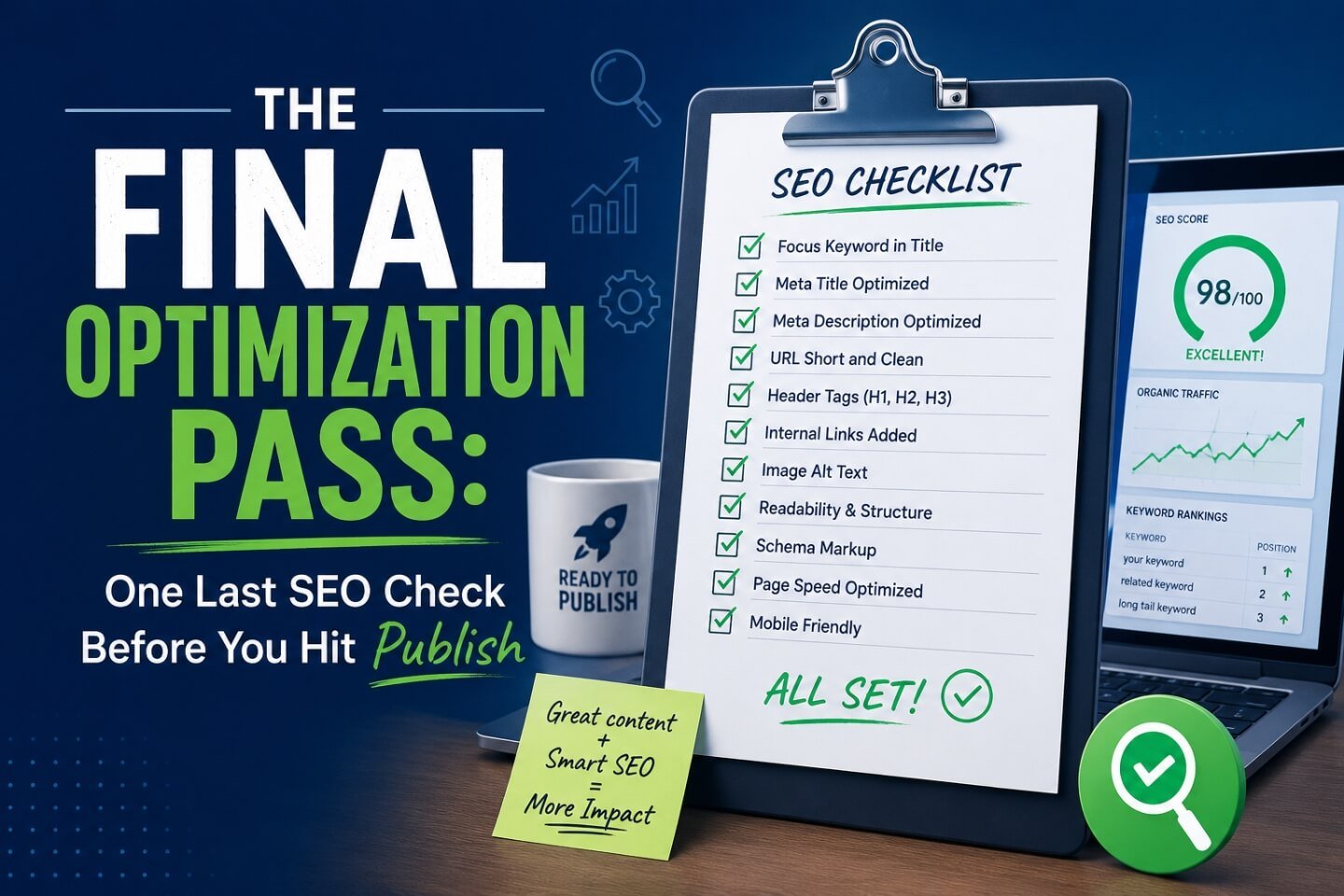
A Pre-Publish SEO Checklist
The Final Optimization Pass automates this, but here’s the pre-publish checklist it effectively runs — a useful reference whether you’re reviewing its output or doing a manual last look:
- Primary keyword in the H1, first 100 words, and 2–3 H2s
- One H1 only, with clean H2 › H3 nesting and no skipped levels
- Meta title (50–60 characters) and meta description (150–160 characters) present and keyword-forward
- URL slug short, readable, and keyword-relevant
- Internal links to relevant pages with descriptive anchor text
- External links live and pointing to credible sources
- Images have descriptive, keyword-aware alt text
- Content depth matches or beats the top-ranking competitors
- Structured for readability and AI extraction (clear sections, direct answers, short paragraphs)
- FAQ section marked up with schema, if present
- Clear introduction and a conclusion with a call to action
Frequently Asked Questions
These answers use the question-first, answer-first structure that AI answer engines and featured snippets extract most reliably.
What does Herenkou's Write SEO Article feature do?
Herenkou’s Final Optimization Pass is the last SEO check before content goes live. It delivers an SEO score from 0 to 100, a prioritized list of fixes, a set of quick wins, multiple meta element options, link enhancement suggestions, and an overall publishing-readiness assessment. It reviews the finished draft as one complete artifact to confirm it’s fully optimized before you publish.
What should I check before publishing a blog post for SEO?
Confirm the primary keyword is in the title, H1, and opening; that meta title and description are present and the right length; that headings are cleanly structured; that internal and external links are in place and working; that images have alt text; and that the content matches competitor depth. A final optimization pass automates this by scoring the page and returning a prioritized, ranked list of what to fix before it goes live.
What is a good SEO score before publishing?
There’s no universal cutoff, but a higher score means fewer optimization gaps remaining. The practical approach is to capture every quick win and address the high-priority fixes before publishing, then use the readiness assessment as your go / not-yet signal. The score matters less as an absolute number than as a guide to what’s still worth fixing in the final pass.
Is a final SEO check really necessary if I optimized while writing?
Yes. Optimizing during writing handles each element in isolation, but details still slip between stages — a blank meta field, a keyword missing from the H1, a weak internal link. A final pass reviews the completed article as a whole and catches the gaps no single earlier stage guarantees, which is why it’s a distinct and worthwhile step even on a carefully written draft.
What is GEO and AEO, and how does a final optimization pass support them?
GEO (generative engine optimization) is optimizing content to be cited by AI engines like ChatGPT, Perplexity, Gemini, and Google’s AI Overviews. AEO (answer engine optimization) is optimizing content to be extracted as a direct answer in snippets and AI answer boxes. A final pass supports both by confirming the signals these engines reward are in place before publishing — clear structure, direct answers, current information, credible links, and schema-ready FAQs — so the page ships ready to rank and ready to be cited.
How do I make sure my article is optimized for AI search before publishing?
Confirm the content leads sections with direct answers, uses clear question-based headings, keeps paragraphs short, supports claims with statistics and citations to credible sources, and includes an FAQ marked up with schema. A final optimization pass verifies these citation-friendly signals are present, which is what makes a finished article eligible to be surfaced and cited by AI answer engines, not just ranked in traditional search.
Does a final SEO pass include meta title and description suggestions?
Yes. Herenkou’s Final Optimization Pass provides multiple meta title and description options as part of the review, so you can choose or test the framing that best fits the search intent and results page. Because meta elements directly influence click-through rate, generating several publish-ready options is a core part of the final pass rather than an afterthought.
When should I run a final optimization pass?
Run it as the last step before publishing, once the draft is written, edited, and considered ready. It’s the gate between “finished draft” and “live page” — the point at which you confirm every on-page element is optimized and get a clear publishing-readiness verdict. Running it last ensures the check reflects the article exactly as it will appear to search engines and readers.
The last few minutes before publishing are where easy SEO points are won or quietly lost. A systematic final pass — a score, a ranked fix list, and a clear readiness verdict — means you ship every article in the best shape it can be, not just the shape it happened to be in when you ran out of time.
See how Herenkou runs a final optimization pass before publish in one last SEO stage, explore how the full workflow fits together, or compare plans and pricing to find the tier that matches your publishing volume.