
Analyze Existing Content
Not every underperforming page needs a full rewrite. Some need a ten-minute tweak. Some need a major expansion. And some aren’t worth touching at all. The problem is that most teams can’t tell which is which — so they either rewrite everything (wasting effort on pages that needed a light touch) or rewrite nothing (leaving easy wins on the table).
The missing step is diagnosis. Before you decide whether to rewrite, you need to know how healthy a page actually is, what’s holding it back, and whether fixing it is worth your time.
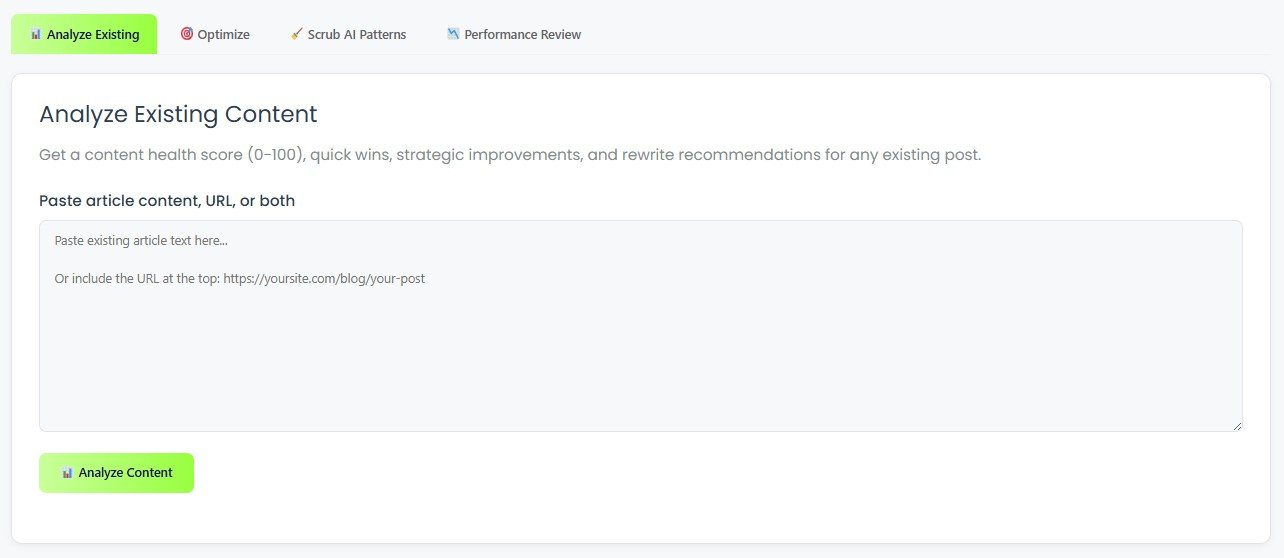
That’s exactly what Herenkou’s Analyze Existing Content feature provides. Point it at a blog post — by URL or by file — and it returns a content health score from 0 to 100, a list of quick wins, a set of longer-term strategic improvements, a clear recommendation on rewrite priority and scope, and a research brief to guide any rewrite that follows.
It’s the triage step that makes every downstream decision smarter. Here’s how it works and why running your content through Herenkou beats auditing it by hand.
Why You Should Analyze Before You Rewrite
Rewriting without analyzing first is guesswork with extra steps. You might spend hours expanding a page that only needed a fresh statistic, or lightly edit a page that actually needed three new sections to compete. Either way, effort goes where it isn’t needed and skips where it is.
Analysis fixes that by answering three questions before any work begins:
- How healthy is this page right now? A single score tells you where it stands, so you can compare pages objectively instead of relying on gut feel.
- What specifically is wrong with it? Vague dissatisfaction (“this post underperforms”) isn’t actionable. A concrete list of issues is.
- Is it worth fixing, and how much? Some pages justify a full rewrite; others justify a quick edit; others aren’t worth the time. Knowing which is the difference between an efficient content program and a busy one.
Diagnosis first means every hour you later spend rewriting is an hour spent on a page that deserves it, doing the work that actually moves the needle.
What the Analyze Existing Content Feature Delivers
You give Herenkou an existing blog post — either a live URL or an uploaded file — and it produces a structured diagnosis with five parts.
A Content Health Score (0–100)
The analysis returns a single content health score from 0 to 100. This is the at-a-glance number that lets you triage a whole library: a page scoring 85 needs light maintenance, a page scoring 40 needs serious work, and you can prioritize accordingly. Scoring content on a consistent scale turns “which pages should we work on?” from an argument into a sorted list.
Quick Wins for Immediate Improvement
Not every fix is a big project. The analysis surfaces quick wins — the small, high-impact changes you can make immediately: a missing meta description, a title that doesn’t lead with the keyword, an H1 problem, a broken internal link, an outdated stat in the intro. These are the changes that take minutes and often deliver a disproportionate return, and having them listed means you can knock them out without a full rewrite.
Longer-Term Strategic Improvements
Alongside the quick fixes, the analysis identifies longer-term strategic improvements — the deeper changes that take more effort but shape the page’s real competitiveness: new sections needed to close content gaps, restructuring for better topic coverage, or a shift in angle to match current search intent. Separating these from the quick wins lets you plan the substantial work deliberately rather than discovering it mid-rewrite.
A Rewrite Priority and Scope Recommendation
This is the decision the whole analysis builds toward: a recommendation on rewrite priority and scope. Should this page be rewritten now, later, or not at all? And if it should, is it a light refresh or a major overhaul? That guidance is what stops you from over-investing in low-value pages and under-investing in high-value ones. It converts a pile of “maybe we should update these” into a ranked, right-sized plan.
A Research Brief to Guide the Rewrite
When a rewrite is warranted, the analysis produces a research brief to guide it — the primary keyword, competitive context, and direction for what the updated page needs to cover. That means the diagnosis flows directly into execution: you don’t finish the analysis and then start research from scratch, because the brief that drives the rewrite is already in hand.
From Analysis to Action: A Connected Workflow
The Analyze Existing Content feature isn’t a standalone audit that leaves you holding a report. It’s the front end of a connected sequence. Analysis produces a health score and a rewrite recommendation; if a rewrite is warranted, the research brief it generates feeds directly into the rewrite stage, which updates the page while preserving what works.
That connection is the point. A standalone audit tool tells you what’s wrong and then leaves the hard part — deciding what to do and doing it — entirely to you. Herenkou’s analysis is designed to hand off cleanly to the next step, so diagnosis, decision, and execution are one flow rather than three disconnected tasks.
Why Using Herenkou Is Better for SEO Content
Auditing content by hand, or with a generic checker, tends to produce either too little or too much: a thin score with no clear next step, or a 200-item report you’ll never work through. Herenkou is better for SEO content specifically because its analysis is built to drive decisions, not just describe problems.
It gives you a decision, not just data. Many tools output a score and a list. Herenkou adds the part that actually matters — a priority-and-scope recommendation — so you know what to do, not just what’s wrong.
It separates quick wins from strategic work. By splitting immediate fixes from longer-term improvements, the analysis lets you capture easy gains today and plan the deeper work properly, instead of lumping everything into one overwhelming list.
It flows straight into execution. The research brief the analysis produces feeds the rewrite stage directly, so there’s no gap between “we should fix this” and “here’s the plan to fix it.”
It makes triage objective and scalable. A consistent 0–100 score across every page turns library-wide prioritization into a simple sort — essential when you’re maintaining dozens or hundreds of posts rather than a handful.
It’s one stage of a complete pipeline. Analysis, research, writing, and rewriting share the same underlying rigor, so the diagnosis you get is grounded in the same competitive data as everything else Herenkou produces.
The compounding benefit for a content team: you stop spending effort on the wrong pages. Analysis ensures the hours you invest in content maintenance go to the pages where they’ll actually change rankings — which is the whole game when resources are finite.
A Practical Example: Triaging Three Pages
Say you have three older posts you suspect are underperforming, and limited time to fix them.
Analyzed, they come back very differently. The first scores 82 — strong structure and depth, but a missing meta description and one outdated statistic. That’s a quick-win page: ten minutes of work, no rewrite. The second scores 58 — it ranks on the edge of page one but the top competitors have all added a comparison section it lacks. That’s a targeted expansion: worth a focused rewrite to close one clear gap. The third scores 34 — thin, off-intent, and outranked by far more comprehensive pages. That’s either a full rebuild or a candidate to leave alone, depending on how much the keyword matters to you.
Without analysis, all three look the same: “old posts that could probably be better.” With it, you know precisely where ten minutes goes, where a focused hour goes, and where not to spend time at all. That’s the entire value of diagnosing before you rewrite.
A Content Analysis Checklist
The feature automates this, but here’s the diagnostic checklist it effectively runs — useful for interpreting its output or spot-checking a page yourself:
- Is the primary keyword present and correctly placed in the title, H1, and opening?
- Are the meta title and description present, correct length, and click-worthy?
- Is the heading structure clean — one H1, logical H2 › H3 nesting?
- Are statistics, examples, and references current?
- Does the content cover the topic as completely as the top-ranking competitors?
- Are there internal links in and out, with descriptive anchor text?
- Are external links live and pointing to credible sources?
- Is the content structured for readability and for AI extraction (clear sections, direct answers)?
- Given all of the above, is this page worth rewriting — and at what scope?
Frequently Asked Questions
What does Herenkou's Analyze Existing Content feature do?
How do I know if a blog post needs to be rewritten or just updated?
What is a content health score?
How do I audit a blog post for SEO?
What is GEO and AEO, and how does content analysis support them?
Can analyzing existing content improve how AI search engines cite my pages?
Should I analyze content by URL or by file?
How often should I audit my existing content?
Before you rewrite anything, know what’s actually worth rewriting. A clear diagnosis — a health score, a prioritized fix list, and a right-sized rewrite recommendation — turns content maintenance from guesswork into a plan.
See how Herenkou analyzes existing content by URL or file in a single diagnostic stage, explore how the full workflow fits together, or compare plans and pricing to find the tier that matches your content library.