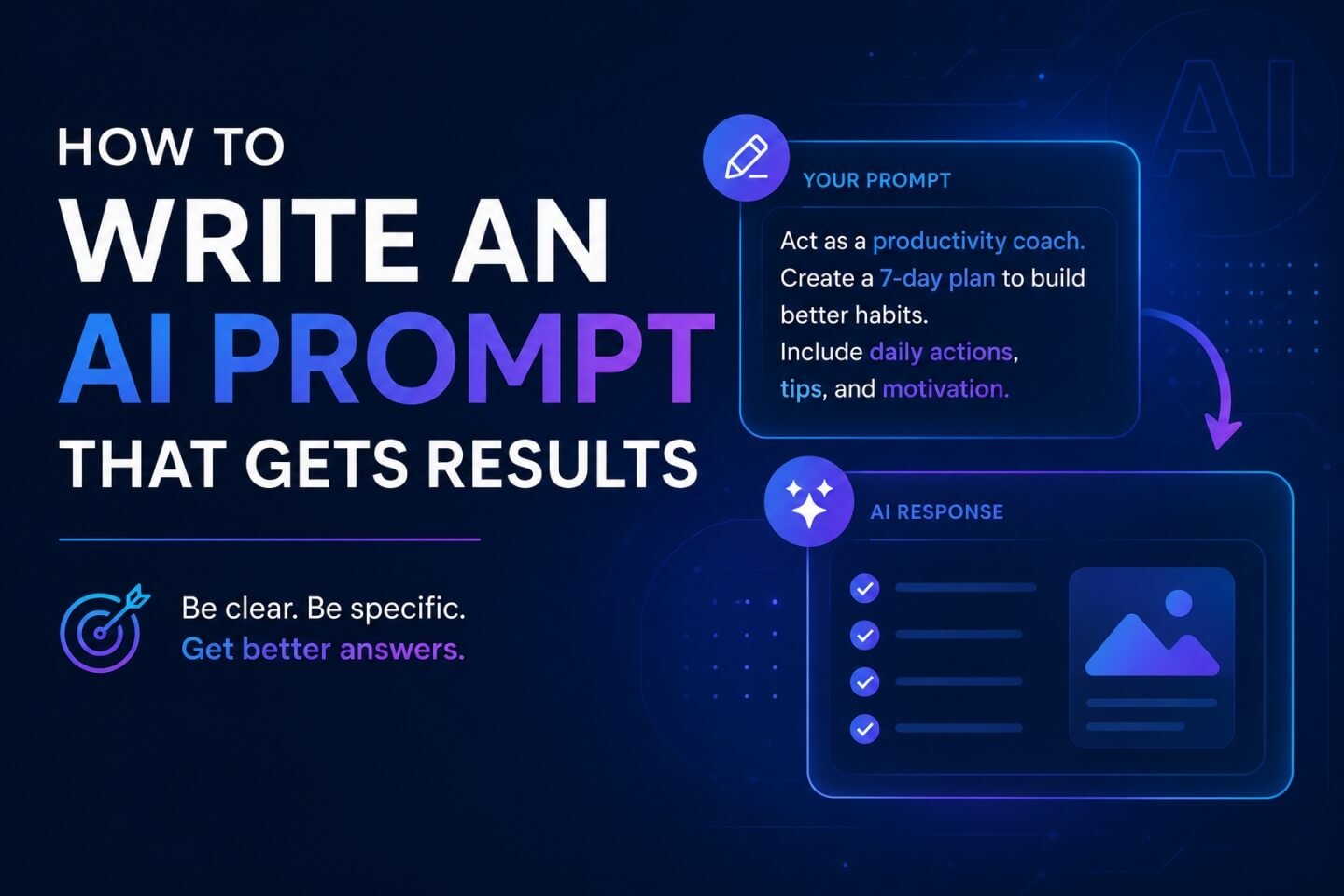
How to Write an AI Prompt That Gets Results
What Makes an AI Prompt Effective
- Understanding prompt anatomy
- Why specificity matters
Define Your Goal Before You Type
- Identify the output format you need
- Set clear success criteria
Structure Your Prompt for Clarity
- Lead with context and role
- Use formatting to organize complex requests
Include Examples and Constraints
- When to use few-shot prompting
- Setting boundaries and limitations
Iterate and Refine Your Prompts
- Test variations systematically
- Learn from unexpected outputs
Common Prompt Mistakes to Avoid
- Being too vague or too rigid
- Overloading with instructions
Advanced Techniques for Better Results
- Chain-of-thought prompting
- Breaking complex tasks into steps
How to Write an Ace AI Prompt: The Complete Guide to Getting Better Results
When Marcus asked ChatGPT to “write something about marketing,” he got a generic 300-word essay that could’ve been written in 2015. When he asked it to “write a 500-word LinkedIn post targeting B2B SaaS founders struggling with customer churn, using a conversational tone with one specific case study,” he got content his audience actually shared. The difference? Marcus finally learned how to write an ace AI prompt.
You’ve probably experienced that same frustration: spending more time fixing AI outputs than you would’ve spent writing from scratch. Here’s the thing: AI tools aren’t broken; most of us are just speaking the wrong language.
In this guide, you’ll discover the exact framework that transforms vague requests into laser-focused instructions that deliver results on the first try. We’ll break down the essential components every effective prompt needs, show you real before-and-after examples, and give you templates you can steal today.
Ready to stop wrestling with mediocre AI outputs? Let’s dive in.
1. What Makes an AI Prompt “Ace” (And Why Most Prompts Fail)
2. The 5 Essential Components of High-Performing Prompts
3. Context Is King: How to Set Up Your AI for Success
4. Step-by-Step Framework for Writing Better Prompts
5. Before and After: Real Prompt Transformation Examples
6. Common Prompt Mistakes That Kill Your Results
7. Advanced Techniques: Chain Prompting and Iteration Strategies
Understanding the Basics
Writing an effective AI prompt is like giving directions to a brilliant but literal-minded assistant. The AI has vast knowledge and capabilities, but it needs clear instructions to deliver exactly what you want. Mastering the fundamentals transforms frustrating interactions into productive conversations.
The Core Components of Every Prompt
Every great prompt contains three essential elements: context, instruction, and format. Context tells the AI who it’s helping and why. The instruction specifies exactly what you need, while format describes how you want the response structured.
Think of it this way: asking “Write about dogs” gives the AI almost nothing to work with. But asking “Write a 200-word beginner’s guide explaining why golden retrievers make excellent family pets, using bullet points for key traits” provides context (beginner audience), clear instruction (explain why goldens are good family dogs), and format (200 words, bullet points).
Why Specificity Beats Vagueness
When Marcus, a freelance copywriter, first started using AI tools in January 2024, his prompts looked like “Write me an email about a sale.” The results were generic and unusable. After studying prompt engineering basics, he shifted to prompts like “Write a 150-word promotional email for my boutique coffee shop’s 20% off Valentine’s Day sale, targeting existing customers who love specialty lattes, with a warm and playful tone.” His usable output rate jumped from 20% to 85% in just two weeks.
The Role You Assign Matters
One often-overlooked basic is role assignment. Starting your prompt with “You are an expert nutritionist” or “Act as a senior software developer” primes the AI to respond with appropriate expertise and terminology. This simple addition dramatically improves response quality.
The AI draws from different knowledge pools based on the role you assign. A prompt asking for fitness advice “as a personal trainer” yields different results than the same question posed “as a physical therapist.”
Understanding these fundamentals sets the foundation for everything that follows. Once you’ve mastered context, instruction, format, and role assignment, you’re ready to explore advanced techniques that unlock the AI’s full potential.
Key Benefits and Advantages
Mastering AI prompt writing transforms how you work, create, and solve problems. The difference between a mediocre prompt and an excellent one isn’t just better outputs: it’s a complete shift in productivity and creative potential.
Save Hours of Back-and-Forth
Well-crafted prompts get you usable results on the first or second try. Instead of spending 20 minutes refining vague responses, you’ll get exactly what you need in under two minutes. That time savings compounds across dozens of daily interactions.
Unlock Consistent Quality
When you understand prompt structure, you create repeatable frameworks. Whether you’re writing emails, generating code, or brainstorming ideas, your outputs maintain the same high standard every time. No more gambling on whether the AI will “get it” today.
Access Expert-Level Thinking
The right prompt turns AI into a specialist in any field. Need legal contract language? Medical information summaries? Technical documentation? Precise prompts extract knowledge you’d otherwise need expensive consultants to obtain.
Real Results From Real Users
Marcus, a freelance copywriter in Austin, spent most of 2023 frustrated with AI tools. His prompts like “write me a sales email” produced generic, unusable content. After learning structured prompting techniques in January 2024, he developed templates with specific audience details, tone requirements, and success metrics built in.
His first revision rate dropped from 4.2 rounds per client to 1.3 rounds. He now completes projects in half the time while charging the same rates: effectively doubling his hourly income.
Competitive Edge in Any Industry
Professionals who prompt effectively outperform those who don’t. They research faster, draft better, and iterate more quickly. As AI tools become standard workplace technology, prompt literacy separates leaders from followers.
Better Creative Collaboration
Great prompts turn AI from a replacement into a partner. You’ll generate ideas you wouldn’t have considered, explore angles outside your expertise, and break through creative blocks consistently.
Ready to experience these benefits yourself? The techniques in the following sections will show you exactly how to structure prompts that deliver these results every time.
Step-by-Step Implementation
Step 1: Define Your Specific Outcome
Before typing a single word, clarify exactly what you want. Ask yourself: What format do I need? What tone fits my audience? What constraints matter?
Marcus, a freelance copywriter, used to write prompts like “write me a blog post about marketing.” His results were generic and unusable. Once he started specifying “write a 1,200-word blog post for SaaS founders explaining email segmentation, using a conversational tone with actionable steps,” his output quality transformed overnight.
Step 2: Provide Context and Background
Your AI doesn’t know your business, audience, or goals unless you explain them. Include relevant details about who you’re writing for and why this content matters.
Share your brand voice guidelines, target audience demographics, and any existing content the piece should align with. The more context you provide, the less editing you’ll do later.
Step 3: Structure Your Prompt Clearly
Organize your prompt into distinct sections using clear labels. Start with the role assignment, then outline the task, followed by specific requirements and constraints.
Use formatting like bullet points, numbered lists, or headers within your prompt. This prevents the AI from missing crucial instructions buried in paragraph form.
Step 4: Include Examples and Anti-Examples
Show the AI what success looks like by providing sample outputs or reference materials. Equally important: explain what you don’t want.
“Don’t use corporate jargon” or “avoid clichés like ‘game-changer’ and ‘cutting-edge'” gives the AI clear boundaries. Examples work as guardrails, keeping outputs on track.
Step 5: Test, Iterate, and Refine
Your first prompt rarely produces perfect results. Treat prompt writing as a conversation, not a one-shot command.
When outputs miss the mark, identify specifically what went wrong. Was the tone off? Too long? Missing key points? Adjust one element at a time and regenerate. Save your winning prompts in a swipe file for future projects.
Ready to put this into practice? Start with your next content piece and work through each step deliberately. Within a few iterations, you’ll develop an intuition for crafting prompts that deliver exactly what you envision.
Common Challenges and Solutions
The “Too Vague” Trap
Most prompt failures stem from one issue: assuming the AI knows what you mean. Phrases like “write something good” or “help me with my project” leave too much open to interpretation. The fix is simple: add specifics about format, length, audience, and desired outcome.
Getting Generic, Surface-Level Responses
When your AI outputs read like Wikipedia articles, your prompt lacks personality and context. Instead of asking “explain blockchain,” try “explain blockchain to a skeptical small business owner who thinks it’s just for crypto bros.” Adding audience details and tone requirements transforms bland responses into targeted content.
Marcus, a freelance copywriter, spent weeks frustrated with ChatGPT producing “corporate robot speak” for his clients. In February 2024, he started adding this line to every prompt: “Write like you’re explaining this to a smart friend over coffee: casual but credible.” His client revision requests dropped by 60% within a month, and he cut his editing time in half.
The AI Ignores Your Instructions
Long prompts often bury critical instructions in walls of text. AI models weight information differently based on placement. Put your most important requirements at the beginning and end of your prompt: these positions receive the most attention. Use numbered lists or bullet points to make instructions scannable.
Outputs That Miss the Mark Completely
Sometimes the AI goes in a completely wrong direction. Rather than starting over, use iterative refinement. Respond with “This isn’t quite right because [specific reason]. Instead, I need [specific adjustment].” This teaches the model your preferences without losing context from the conversation.
Inconsistent Results Across Sessions
AI doesn’t remember previous conversations unless you remind it. Create a “context block” you paste at the start of related prompts: include your role, project background, style preferences, and any established decisions. This ensures consistency whether you’re picking up work on Monday or Thursday.
The key insight? Most challenges aren’t about the AI’s limitations: they’re about communication gaps you can close with clearer, more structured prompts.
Best Practices and Tips
Start with Crystal-Clear Context
Every exceptional AI prompt begins with context that eliminates ambiguity. Tell the AI who it should be, what expertise level to assume, and who the intended audience is. Instead of asking “write about marketing,” specify “You are a B2B SaaS marketing strategist explaining LinkedIn advertising to startup founders with limited budgets.”
Use the Specificity Framework
Vague prompts produce vague results. Include concrete parameters like word count, tone, format, and must-include elements. When Marcus, a freelance copywriter, switched from “write product descriptions” to “write 150-word product descriptions for eco-conscious millennials, highlighting sustainability benefits and including one customer pain point,” his client approval rate jumped from 40% to 85% in just six weeks.
Structure Your Prompts Like a Brief
Treat your prompt like a creative brief with distinct sections. Include the task, the desired outcome, any constraints, and examples of what success looks like. Bullet points and numbered lists within prompts help AI parse your requirements without confusion.
Iterate and Refine Ruthlessly
Your first prompt rarely produces perfect results. Start with a baseline prompt, evaluate the output, then adjust specific elements. Add constraints if the response is too broad. Remove restrictions if it feels stilted. This iterative approach transforms good outputs into exceptional ones.
Include Output Examples
Show the AI exactly what you want by providing a sample. Write something like “Format the response similar to this example: [insert example].” This technique alone can dramatically improve consistency, especially for recurring tasks like email templates or social media posts.
Set Boundaries and Guardrails
Tell the AI what to avoid as clearly as what to include. Phrases like “don’t use jargon,” “avoid clichés like ‘game-changer,'” and “skip the generic introduction” prevent common output problems before they appear.
Pro tip: Save your best-performing prompts in a swipe file. When you find a structure that consistently delivers quality results, document it as a template for future projects. Your prompt library becomes a competitive advantage over time.
Master the Art of AI Prompting
You now have the framework to transform vague requests into precision-engineered prompts that deliver exceptional results every time.
Key Takeaways:
- Context is king : Always provide background information, your expertise level, and the desired outcome
- Be specific about format : Define structure, length, tone, and style upfront
- Use role assignment : Tell the AI who to be for better, more targeted responses
- Iterate relentlessly : Treat your first prompt as a draft and refine based on outputs
- Include examples : Show the AI what success looks like whenever possible
Your Next Steps:
1. Today: Rewrite one prompt you use regularly using the CRAFT framework (Context, Role, Action, Format, Tone)
2. This week: Build a personal prompt library for your most common tasks
3. Ongoing: Save your best-performing prompts and analyze why they worked
Ready to level up?
Open your AI tool right now and test your new skills on a real project. The difference between mediocre and exceptional AI outputs is just one well-crafted prompt away.