Most content that fails to rank didn’t fail in the writing. It failed before a single word was typed — in the research phase, where the wrong keyword got chosen, the competition never got studied, and the outline was built on a hunch instead of evidence.
Keyword research and competitive analysis are the two disciplines that decide whether your next article has a real shot at page one or is dead on arrival. Done well, they hand you everything you need before you write: a primary keyword you can actually win, a clear map of who you’re up against, the gaps in their content you can exploit, a ready-to-use outline, and the meta elements to match. Done poorly — or skipped — you’re gambling.
This guide walks through what these two processes involve, how to do them properly, the mistakes that quietly sink most attempts, and how Herenkou.com compresses the entire workflow into a single research brief instead of an afternoon spread across four tools.
What Keyword Research & Competitive Analysis Actually Means
These two get discussed as separate tasks, but they only produce useful results when you treat them as one connected process.
Keyword research answers a demand question: what are people actually searching for, how many of them, and what do they want when they search it? A good keyword research process surfaces three things — search volume (how much traffic the term could drive), search intent (whether the searcher wants information, a comparison, or to buy), and difficulty (how hard it will realistically be to rank).
Competitive analysis answers the follow-up: who is already winning this search, and what would it take to beat them? That means examining the current top 10 ranking pages for a term — their content depth, structure, angle, authority, and, most importantly, what they leave out.
Here’s why they’re inseparable. Do keyword research alone and you’ll pick terms you can’t realistically win, because you never checked who’s defending them. Do competitive analysis alone and you’ll build beautiful content around a keyword with too little search volume to matter. You need both, together, before you commit to a topic.
Step One: Finding Keywords Worth Targeting
Keyword research usually starts with “seed” keywords — the broad terms that describe what you do. From there, the goal is to expand into the specific, winnable variations that sit underneath them.
A few principles separate good keyword selection from bad:
- Specificity beats volume. A broad term like “project management” has enormous search volume and enormous competition. A long-tail variation like “project management for remote design teams” has a fraction of the volume but a far higher chance of ranking — and it attracts readers who are closer to actually needing what you offer.
- Intent has to match your goal. An informational keyword (“how does keyword research work”) suits a top-of-funnel guide. A commercial one (“best keyword research tool”) suits a comparison piece. Targeting the wrong intent means even a ranking article won’t convert.
- Difficulty has to match your site. This is the factor generic advice usually ignores. A keyword rated “medium difficulty” in a general tool might be completely out of reach for a newer domain and completely winnable for an established one. Difficulty is only meaningful relative to your own site’s authority.
That last point is where a lot of keyword research goes wrong. A number that isn’t calibrated to your specific domain is just a generic estimate — useful for direction, useless for a final decision.
Step Two: Studying the Competition
Once you have a candidate keyword, the next question is whether you can actually beat what’s already there. This is where you pull the top 10 results and study them like a competitor would study you.
For each ranking page, note:
- Word count and depth. Are the top results 800-word overviews or 3,000-word deep dives? This sets a rough bar for what Google currently rewards on this term.
- Structure. What subtopics do they cover, and in what order? Recurring headings across multiple top results signal what searchers (and the algorithm) expect to see.
- Angle. Are they all saying the same thing? Uniformity across the top 10 is an opportunity — it means a genuinely different perspective can stand out.
- Authority. Are these massive, established domains or beatable mid-size sites? This tells you how steep the climb is.
- Gaps. This is the most valuable observation of all — the questions left unanswered, the stats that are outdated, the subtopics barely touched.
Those gaps are your entire reason for writing. If you can’t find something the top results are missing, you’re not adding to the conversation — you’re duplicating it, and duplicate content rarely outranks the original.
Step Three: Identifying Content Gaps
Content gap analysis deserves its own focus because it’s where competitive analysis turns into a competitive advantage.
A content gap is any valuable angle, subtopic, question, or data point that the currently ranking pages fail to cover well. They tend to fall into a few categories:
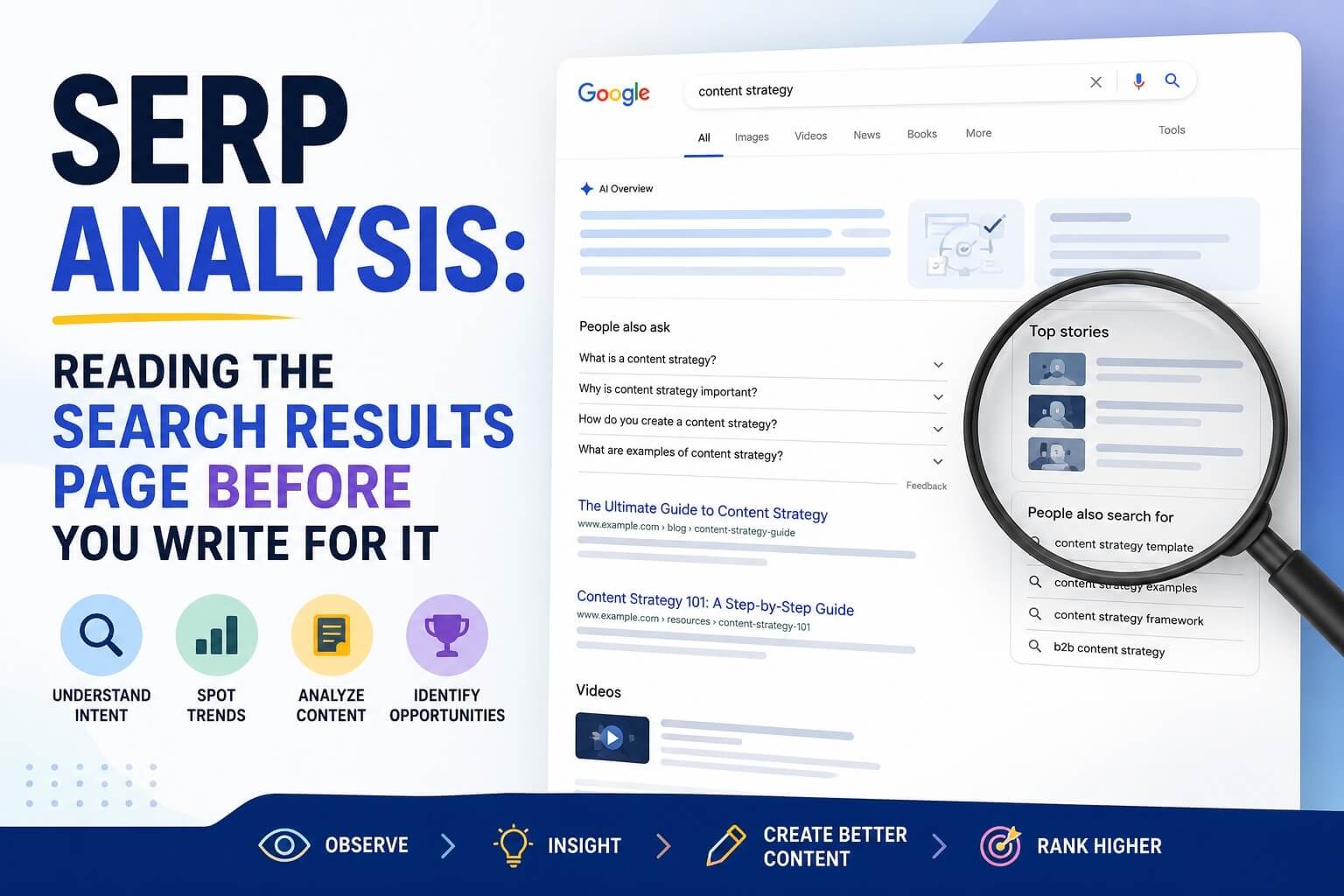
- Unanswered questions. Check the “People Also Ask” boxes and related searches. If the top results don’t directly answer a question searchers are clearly asking, that’s a gap you can fill with a dedicated section.
- Outdated information. Articles that ranked two years ago may cite stale statistics, reference deprecated tools, or miss recent developments. Freshness alone can be a differentiator.
- Shallow coverage. A topic that every competitor mentions in one paragraph but nobody explains thoroughly is an invitation to become the definitive resource.
- Missing formats. If every ranking page is a wall of text and none includes a comparison table, a checklist, or a worked example, adding one can improve both ranking and reader experience.
The output of this step is a short list of specific things your article will do that the competition doesn’t. That list is what makes your content worth ranking.
Step Four: Turning Research Into a Brief
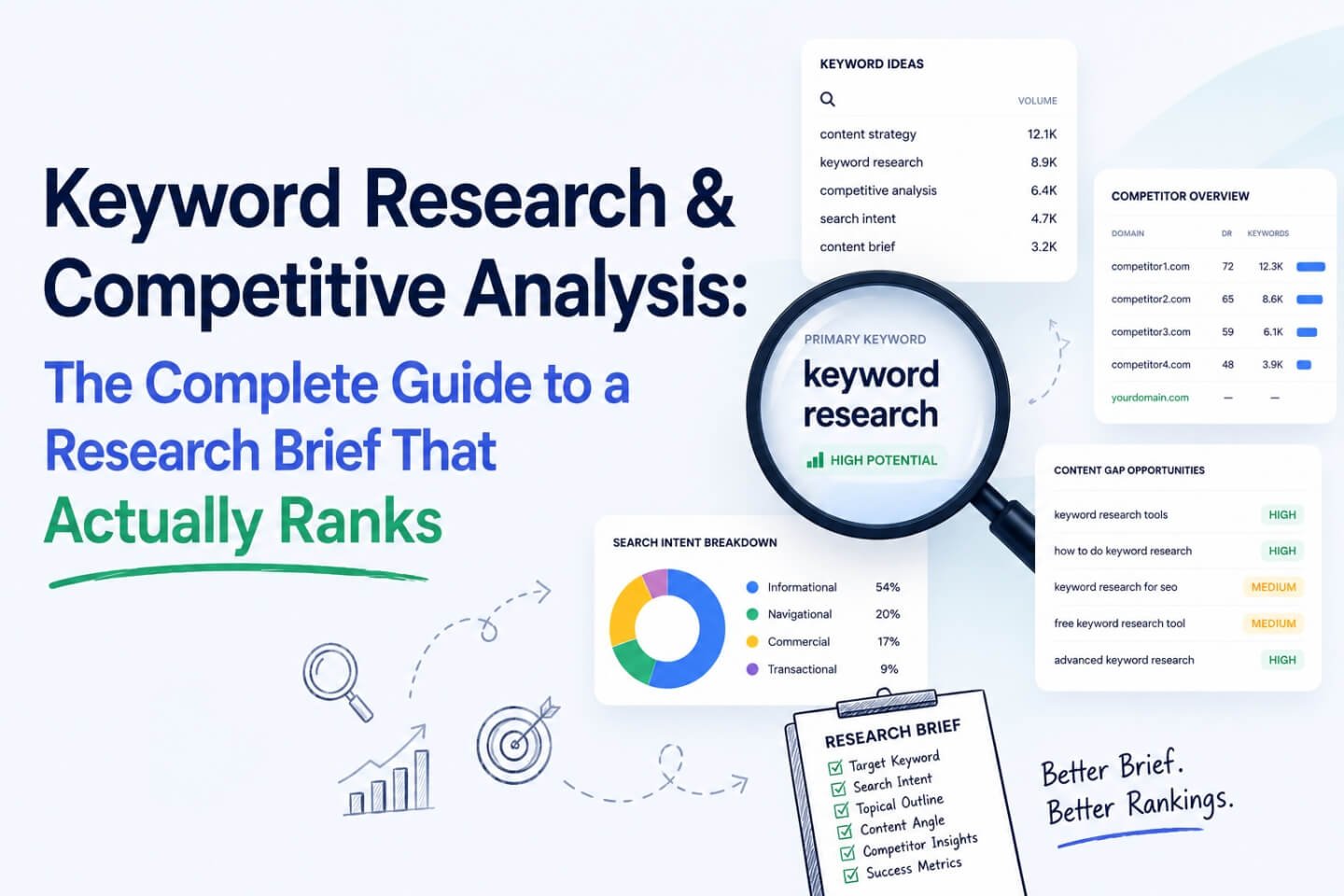
All of the above is only useful if it becomes a plan you can hand to a writer — including yourself. A complete research brief answers five questions:
- What’s the primary keyword, and is it realistically winnable for this site right now?
- Who occupies the top 10, and what does their content look like — length, structure, angle, authority?
- What are they missing that we can cover better?
- What outline gives us the best shot at covering the topic more completely than what’s already ranking?
- What meta title and description will accurately represent the piece and earn the click in a crowded results page?
Most tools give you one or two of these. Getting all five usually means stitching output together from separate platforms — a keyword tool for volume, a SERP tool for competitors, a manual pass for gaps, and a doc where you assemble it all by hand. That fragmentation is exactly the friction Herenkou is built to remove.
The Old Way: Spreadsheets, Tabs, and Guesswork
If you’ve done this manually, the workflow is painfully familiar. Pull keyword ideas from one tool. Check volume in another. Open the top 10 results one by one to see what they cover. Take notes in a doc. Try to reverse-engineer an outline from the mess. Then, right before publishing, bolt on a meta title and description as an afterthought.
It’s slow, it’s easy to lose the thread, and it rarely accounts for your specific site’s authority. The real cost isn’t the lost hours — it’s the outcome: content built on a keyword you can’t win, missing the exact subtopics that would have made it competitive, with metadata treated as a formality instead of a click-driver.
How Herenkou Handles This in One Pass
This is where Herenkou is different. Its Keyword Research & Competitive Analysis feature is built to answer all five brief questions in a single pass, rather than requiring you to assemble one from multiple exports.
Here’s what that brief includes:
- Keyword research that surfaces terms with real search volume and intent, scored against your site’s actual domain authority rather than a generic difficulty number that ignores who you are.
- Analysis of the top 10 competitors, so you can see exactly what you’re up against — depth, structure, and angle — before committing to a topic.
- Content gap identification, surfacing what the competition left out: the angle, subtopic, or data point that gives your piece a reason to exist.
- A comprehensive research brief that pulls it all together — primary keyword, competitive landscape, recommended outline, and meta elements — in one place instead of four.
The advantage isn’t that any single one of these is unavailable elsewhere. It’s that you get them together, calibrated to your own site, in the time it used to take to complete just the first step.
A Practical Example: Two Keywords, One Decision
Say you’re choosing between two topics: “email marketing automation” and “email marketing automation for small teams.”
Keyword research alone tells you the first has far higher search volume — tempting on its own. Competitive analysis tells you it’s dominated by established platforms with years of backlinks and comprehensive guides, making it a genuinely difficult page to outrank. The second term has a fraction of the volume, but the top-ranking pages are thinner, older, and missing practical, small-team-specific examples.
A combined research brief exposes that trade-off immediately — before you’ve spent a week writing the article you had almost no chance of ranking. That’s the difference between research that informs a decision and research that just produces data.
Manual Research vs. a Unified Research Brief
Step | Manual, Multi-Tool Approach | Unified Research Brief |
Keyword discovery | One tool for ideas, another for volume | Ideas + volume + intent together |
Difficulty scoring | Generic score, not tied to your site | Calibrated to your domain authority |
Competitor analysis | Open top 10 results one by one | Top 10 analyzed and summarized in one view |
Content gaps | Manual note-taking across tabs | Gaps surfaced automatically |
Outline | Reverse-engineered by hand | Recommended outline built from the data |
Meta elements | Added as an afterthought | Included in the brief upfront |
Common Mistakes to Avoid
Even with good data in hand, a few habits quietly undermine keyword and competitive research:
- Chasing volume over winnability. A high-volume keyword you can’t crack in the next year isn’t a priority — it’s a distraction from the terms you could rank for this quarter.
- Analyzing competitors once and never again. Rankings shift constantly. A gap you spotted three months ago may already be filled, and a term that was competitive may have opened up.
- Treating the outline as optional. Jumping straight to a draft without mapping what the top results cover is the fastest way to accidentally duplicate content that already exists.
- Writing metadata last. Your meta title and description are often the first thing a searcher sees. They deserve the same attention as the H1, not a rushed line before publishing.
- Ignoring search intent. A perfectly optimized informational article will never rank for a keyword where Google clearly wants to show product pages. Match the format to the intent.
Frequently Asked Questions
What comes first, keyword research or competitive analysis?
How many competitors should I analyze for a keyword?
What is a content gap in SEO?
Why does keyword difficulty need to be calibrated to my site?
Can I do keyword research and competitive analysis without paid tools?
Getting Started
Good content starts before the first sentence — with a clear-eyed look at what you’re competing against and a plan built around the gaps you can actually fill. If you’re doing that research by hand across four tools right now, the friction is a signal, not a normal cost of doing business.
See how Herenkou compresses keyword research, competitor analysis, gap identification, and brief-building into a single research brief, or compare plans and pricing to find the tier that fits your content volume.