Knowing what’s wrong with a landing page is useful. Knowing exactly what to do about it, in what order, and how to test whether it worked is what actually lifts conversions. Most conversion work stalls in the gap between those two: a page gets reviewed, problems get noted, and then the findings sit in a document because no one turned them into a clear, ranked plan of action.
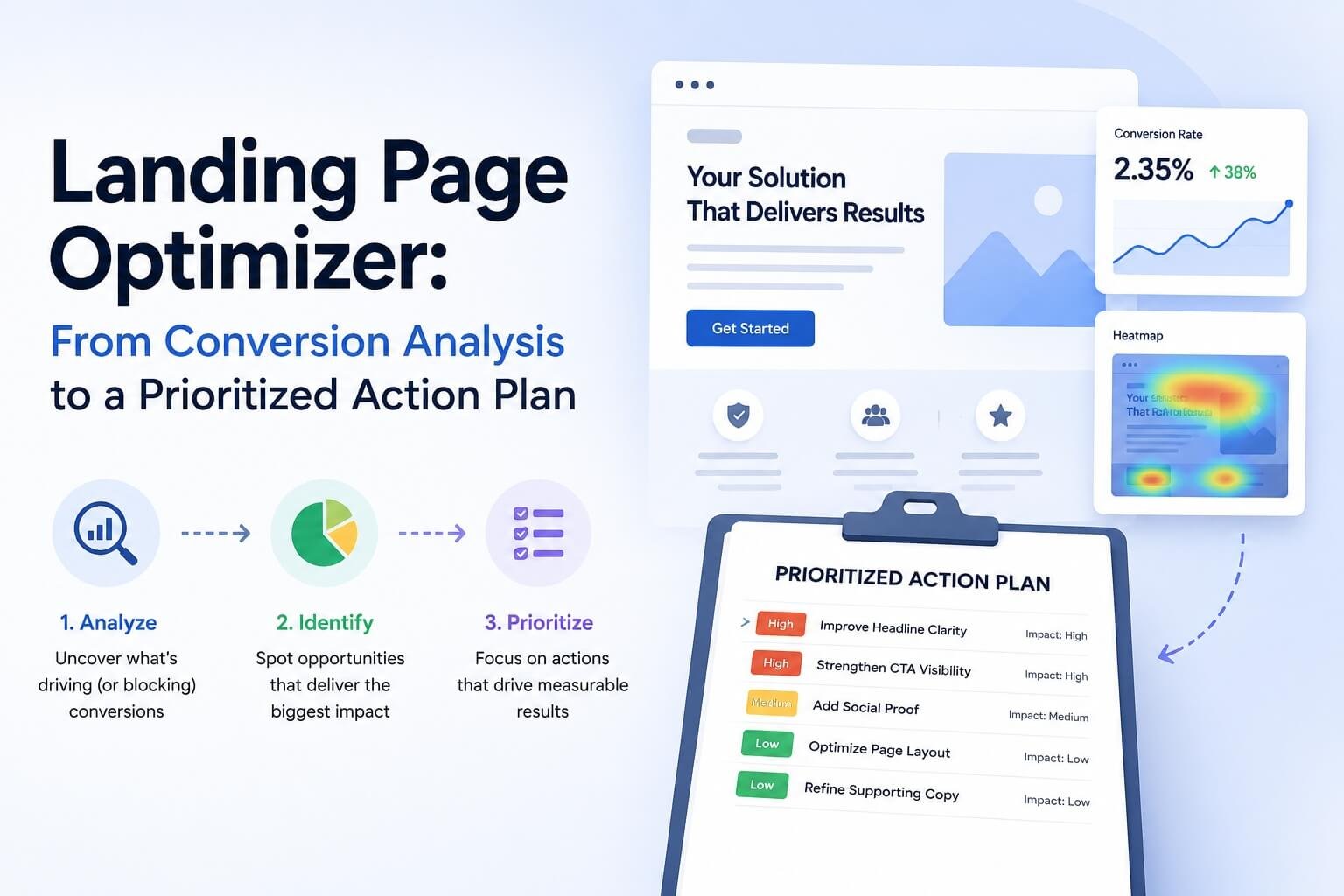
Herenkou’s Landing Page Optimizer is built to bridge that gap. Building on the conversion analysis, it delivers comprehensive optimization recommendations: a CRO score from 0 to 100 broken down by category, detailed analysis across above-fold content, calls to action, trust signals, structure, and SEO, A/B testing recommendations, and a prioritized action list. It doesn’t just tell you the page underperforms. It tells you what to change, why, in what order, and how to prove the change worked.
Here’s what the Landing Page Optimizer delivers, how it differs from a conversion analysis on its own, and why running it through Herenkou beats assembling an optimization plan by hand.
Why Recommendations Beat Raw Analysis
A conversion analysis identifies problems. That’s a necessary first step, but a list of problems isn’t a plan. Two pages with the same set of issues might warrant completely different priorities depending on which fixes are easiest, which touch the most visitors, and which are most likely to move the number. Without that layer of judgment, you’re left staring at findings and guessing where to start.
The Landing Page Optimizer adds the missing layer. It converts analysis into direction: scored, categorized, prioritized, and paired with a way to validate each change. That shift matters because optimization effort is finite. You can’t rebuild an entire page at once, and you shouldn’t. You need to know which handful of changes will produce the most improvement for the least effort, and which can wait. A prioritized plan answers that; a raw analysis doesn’t.
There’s also the question of proof. Even a smart change is a hypothesis until the data confirms it. Recommendations that come with A/B testing guidance let you verify that a change actually helped rather than assuming it did, which protects you from “improvements” that quietly hurt.
What the Landing Page Optimizer Delivers
Point Herenkou at a landing page and the Optimizer returns a structured optimization package with four main components.
A CRO Score (0–100), Broken Down by Category
The Optimizer produces a conversion rate optimization score from 0 to 100, and crucially, it breaks that score down by category rather than handing you a single opaque number. You see how the page performs on each dimension separately, so you can tell at a glance whether your weakness is the fold, the CTAs, the trust signals, the structure, or the SEO. A page might score well overall but hide a serious weakness in one category, and the breakdown surfaces exactly that. It turns a vague “this page could be better” into a specific “this page is strong everywhere except trust signals.”
Detailed Analysis Across Five Categories
Behind the score sits detailed analysis across five areas, each examined on its own terms:
- Above-fold content — whether the first screen communicates value and prompts action before the visitor scrolls or leaves.
- Calls to action — whether the CTAs are clear, compelling, and placed where visitors are ready to act.
- Trust signals — whether testimonials, reviews, logos, guarantees, and other social proof are present and positioned to build confidence.
- Structure — whether the page flows logically toward the conversion and guides attention rather than scattering it.
- SEO — whether the page is optimized to rank, so it earns the traffic it then works to convert.
That last category is what makes the Optimizer distinct from a pure conversion tool. By analyzing SEO alongside the four conversion dimensions, it treats ranking and converting as the connected problem they actually are. A landing page needs both: visibility to attract visitors and persuasion to convert them, and the Optimizer covers both in one assessment.
A/B Testing Recommendations
Recommendations are hypotheses until tested, and the Optimizer treats them that way. It provides A/B testing recommendations, suggesting specific changes worth testing and giving you a path to validate improvements with real visitor data rather than assumption. This is what separates disciplined optimization from guesswork. Instead of changing a headline and hoping, you test the new headline against the old one and let the conversion data decide. Over time, that test-and-learn approach compounds into a page shaped by evidence, not opinion.
A Prioritized Action List
Finally, the Optimizer delivers a prioritized action list, ranking the recommended changes so you know what to tackle first. This is the component that turns everything else into forward motion. Rather than an unordered set of suggestions, you get a sequence: the high-impact, low-effort changes at the top, the larger projects positioned appropriately, and a clear starting point. When time is limited, the priority ranking tells you where the first hour should go.
How the Optimizer Differs From the CRO Analysis
Herenkou offers both a conversion analysis and this Landing Page Optimizer, and the relationship between them is worth making explicit, because they work as a pair.
The CRO analysis is the diagnostic layer. It evaluates the page across the conversion dimensions and identifies where it’s strong and where it’s losing visitors. It answers, “What’s happening on this page?”
The Landing Page Optimizer builds on that analysis to answer the next question: “So what should I do about it?” It adds the scored category breakdown, the SEO dimension, the A/B testing guidance, and the prioritized action list. In other words, the analysis diagnoses and the Optimizer prescribes, scores, and sequences the treatment.
You can think of it as the difference between a diagnosis and a treatment plan. The diagnosis tells you what’s wrong; the treatment plan tells you what to do, in what order, and how to check that it’s working. The Optimizer is where conversion analysis becomes an executable plan.
Why Using Herenkou Is Better for Landing Pages
Building a comprehensive, prioritized optimization plan by hand is demanding work. It requires evaluating every dimension consistently, scoring them objectively, designing sensible tests, and ranking the results by impact, all without letting a favorite theory skew the priorities. Herenkou makes that systematic.
It scores every category, every time. The categorized 0–100 breakdown means no dimension gets skipped and each is assessed on the same scale, so you can see precisely where a page is weak instead of forming a general impression.
It unites SEO and conversion. Most tools handle either ranking or converting. By analyzing SEO alongside the conversion dimensions, the Optimizer addresses the full journey from search result to completed action in one place, rather than forcing you to reconcile two separate audits.
It makes testing part of the plan. A/B testing recommendations build validation into the workflow, so you’re set up to prove what works rather than guess, which is the difference between optimization that reliably improves a page and changes that merely feel like improvements.
It prioritizes for you. The ranked action list turns a pile of findings into a sequence you can execute, focusing limited time on the changes most likely to move the number first.
It completes the funnel within one workflow. Herenkou already helps you research, write, and rank content that draws traffic. The Landing Page Optimizer extends that same rigor to converting the traffic once it arrives, closing the loop from visibility to conversion inside a single connected system.
The strategic payoff is a page optimized for the whole journey, not half of it. A landing page that ranks but doesn’t convert wastes its traffic; a page that converts but doesn’t rank never gets the chance. Optimizing both together, with a scored, tested, prioritized plan, is how a landing page becomes an asset that both attracts and delivers.
A Landing Page Optimization Checklist
The Optimizer automates this, but here’s the checklist it effectively runs, useful for reviewing its output or working through a page yourself:
- Does each category (fold, CTAs, trust signals, structure, SEO) have a clear score, and which is weakest?
- Does the above-fold area communicate value and show the primary action immediately?
- Are CTAs clear, compelling, and well-distributed across the page?
- Are trust signals present, credible, and well-placed?
- Does the page structure flow logically toward the conversion?
- Is the page optimized to rank for its target keyword, not just to convert?
- Which recommended changes are high-impact and low-effort, and are they at the top of the list?
- For each significant change, is there an A/B test to validate it?
- Is there a clear, ordered starting point rather than an undifferentiated list?
Frequently Asked Questions
These answers use the question-first, answer-first structure that AI answer engines and featured snippets tend to extract.
What does Herenkou's Landing Page Optimizer do?
Herenkou’s Landing Page Optimizer delivers comprehensive optimization recommendations for a landing page, building on its conversion analysis. It provides a CRO score from 0 to 100 broken down by category, detailed analysis across above-fold content, calls to action, trust signals, structure, and SEO, A/B testing recommendations, and a prioritized action list. It turns a conversion analysis into an executable, ranked plan for improving the page.
What is a good CRO score for a landing page?
There’s no universal number, but a higher score means fewer conversion barriers remaining, and a category breakdown matters more than the overall figure. A page might score well overall while hiding a serious weakness in one area, such as missing trust signals or a weak fold. The practical approach is to use the category scores to find the weakest dimension and prioritize improvements there, then validate the changes with testing.
How do I optimize a landing page for conversions?
Start by evaluating the page across the key conversion dimensions: above-the-fold clarity, calls to action, trust signals, page structure, and the paths visitors take to act. Identify the weakest areas, make targeted changes, and validate them with A/B testing rather than assuming they helped. Prioritize high-impact, low-effort changes first. Tools like Herenkou’s Landing Page Optimizer automate this by scoring each category and producing a prioritized, testable action plan.
What is A/B testing, and why does it matter for landing pages?
A/B testing compares two versions of a page or element, showing each to a portion of visitors to see which converts better. It matters because it replaces assumption with evidence: a change that seems like an improvement might actually hurt conversions, and testing reveals which is which using real visitor behavior. Building A/B testing into landing page optimization ensures that changes are validated rather than guessed, so improvements are real and measurable.
Should a landing page be optimized for SEO or conversions?
Both, because they solve different halves of the same problem. SEO earns the traffic by helping the page rank and get discovered; conversion optimization turns that traffic into action. A page optimized only for SEO attracts visitors it fails to convert, while a page optimized only for conversion never attracts enough visitors to matter. The Landing Page Optimizer analyzes SEO alongside conversion dimensions specifically so both are addressed together.
What is GEO and AEO, and how do they affect landing page optimization?
GEO (generative engine optimization) is optimizing content to be cited by AI engines like ChatGPT, Perplexity, Gemini, and Google’s AI Overviews. AEO (answer engine optimization) is optimizing content to be extracted as direct answers in snippets and AI answer boxes. They increasingly shape how visitors find landing pages, as more discovery happens through AI-driven search. That makes optimizing the page for both ranking and conversion more valuable, since the qualified traffic these engines send needs a page built to convert it.
How is the Landing Page Optimizer different from a conversion analysis?
A conversion analysis diagnoses a page, identifying where it’s strong and where it’s losing visitors. The Landing Page Optimizer builds on that diagnosis to prescribe action: it adds a scored category breakdown, an SEO dimension, A/B testing recommendations, and a prioritized action list. In short, the analysis tells you what’s wrong, and the Optimizer tells you what to do about it, in what order, and how to confirm it worked.
How often should I optimize my landing pages?
Optimize a landing page when it launches, whenever its conversion rate declines, and on a recurring basis for your highest-value pages. Visitor expectations, competitors, and traffic sources shift over time, so a page that performed well previously may have new room to improve. Treating optimization as an ongoing, test-driven process rather than a one-time project keeps your most important pages converting at their best.
A conversion problem you can’t act on is just a source of frustration. What turns a struggling landing page around is a clear, scored, prioritized plan, backed by tests that prove each change earned its place. That’s the difference between knowing a page underperforms and actually fixing it.
See how Herenkou turns conversion analysis into an executable plan with the Landing Page Optimizer, explore how the full workflow fits together, or compare plans and pricing to find the tier that matches your needs.