
Rewrite & Update Existing Content
Every content team has them: pages that ranked well two years ago and have quietly slipped, posts with stats that are now out of date, articles that were solid at the time but no longer cover everything searchers — or AI engines — expect. They’re not failures. They’re your single biggest untapped source of SEO growth.
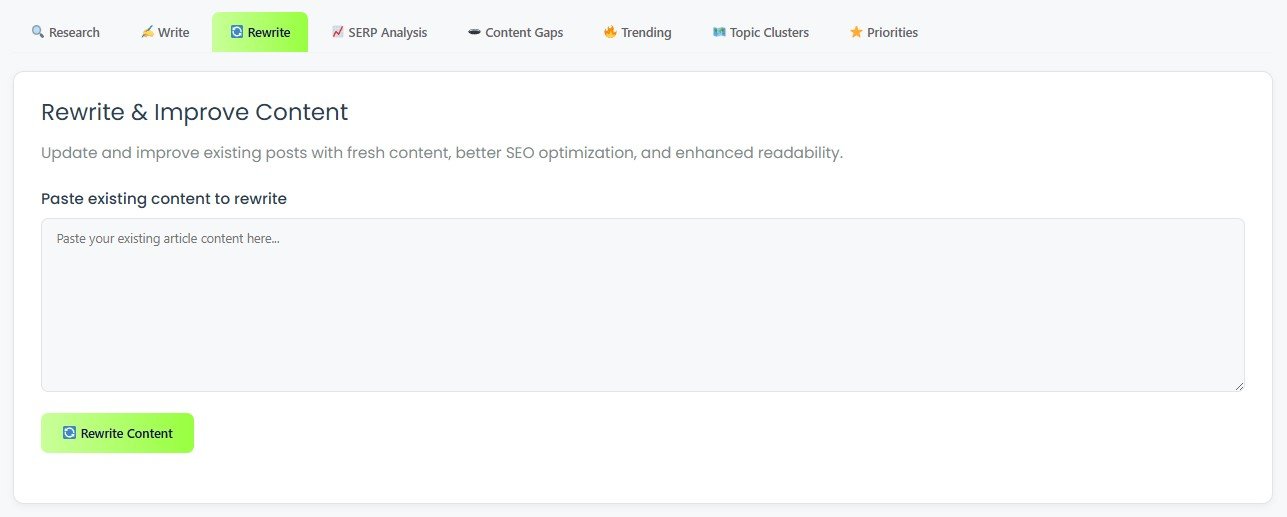
Starting every piece from a blank page ignores that. The faster win is usually updating what you already have: refreshing the statistics and examples, tightening the on-page SEO, adding sections to close the gaps competitors have since filled, and keeping intact whatever already works. That’s precisely what Herenkou’s Rewrite & Update Existing Content feature does — and it does it while tracking every change, so you always know exactly what moved and why.
Here’s how the feature works, why refreshing existing content is often smarter than writing new, and why doing it through Herenkou beats a manual rewrite.
Why Updating Existing Content Beats Starting Over
New content starts from zero. It has no ranking history, no accumulated links, no established trust with search engines. It has to earn all of that from scratch, which takes time.
An existing page that once ranked already has those assets. Updating it builds on a foundation instead of laying a new one — which is why refreshing a page that has slipped often produces faster gains than publishing something entirely new on the same topic. You’re recovering and extending authority you already earned, not starting the climb over.
There’s a second reason this matters more in 2026 than it did a few years ago: freshness has become a ranking and citation signal in its own right. Content that isn’t kept current loses visibility — not just in traditional search, but in AI answer engines, which increasingly favor recently updated sources and drop stale ones from the pages they cite. A page that was authoritative in 2023 can quietly stop being cited simply because newer, fresher sources have replaced it. Regular updates keep your best content in the running.
So the smartest content strategy isn’t “always write new.” It’s “update what’s slipping, and write new where nothing exists yet.” Herenkou’s rewrite feature is built for the first half of that equation.
What the Rewrite & Update Feature Actually Does
The feature works from prior analysis — the same research and competitive data that drives Herenkou’s other stages — and applies it to a page you already have. Rather than regenerating the article from scratch, it makes targeted improvements across four dimensions:
Refreshing statistics and examples.
Outdated numbers and stale references are one of the clearest signals that a page hasn’t been maintained. The rewrite updates them, so your content reflects current data and relevant, recognizable examples instead of ones that date the piece.
Improving on-page SEO.
The update tightens the elements that drive rankings: keyword placement in the title, headings, and opening; heading structure; meta elements; and internal linking. Anything that has fallen behind current best practice gets corrected.
Adding new sections to close content gaps.
Search results evolve. Subtopics that didn’t matter when the article was written may now be things every top-ranking competitor covers. The rewrite adds sections to fill those gaps, bringing the page back to competitive depth.
Preserving what already works.
This is the part manual rewrites and generic AI tools most often get wrong. A good update doesn’t discard the sections that are already ranking, converting, or reading well — it keeps them. Herenkou’s rewrite is designed to improve the weak parts while protecting the strong ones, so you don’t accidentally break a page while trying to fix it.
Every Change, Tracked
One of the biggest risks in rewriting content is losing track of what changed. When you edit a live page by hand, it’s easy to lose the original, forget which sections you altered, or realize weeks later that a change hurt more than it helped — with no clean record to roll back to.
Herenkou removes that risk by tracking every change made during the rewrite. You get a clear account of what was updated, added, or preserved, rather than a mystery diff between “before” and “now.” That record is what lets you rewrite with confidence: if a change doesn’t perform, you can see exactly what it was and reverse it.
Organized Output: A Rewrites Folder, Named by Topic and Date
The updated article is saved to a dedicated rewrites folder, named by topic and date. That sounds like a small detail, but for a team maintaining a large content library, it’s the difference between an organized refresh program and a pile of untitled documents no one can find later.
Naming by topic and date means you can see at a glance what was updated and when — which supports a proper freshness cadence. If you’re aiming to review and refresh key pages on a regular schedule (a sound practice given how much freshness now affects both rankings and AI citation), a clearly organized, dated archive is what makes that cadence trackable instead of aspirational.
The Deliverable: Rewrite, Change Summary, and Before/After Comparison
Each rewrite arrives as a complete package, not just a new version of the file:
- The rewritten content — the updated, re-optimized article, ready to review and publish.
- A summary of changes — a plain-language account of what was refreshed, improved, added, and preserved, so you understand the update without reverse-engineering it.
- A before/after comparison — a direct view of the original against the update, so you can evaluate every change on its merits before anything goes live.
That before/after view is what makes the feature trustworthy. You’re never asked to accept a rewrite on faith — you can see precisely what changed and decide whether each change is an improvement. It keeps you in control of your own content while removing the manual labor of producing the update.
Why Using Herenkou Is Better for SEO Content
It updates from analysis, not guesswork.
It protects what's working.
It's accountable.
It's organized to scale.
It fits a complete workflow.
For a content operation, the compounding value is real
A Content Refresh Checklist
The rewrite feature handles the heavy lifting, but here’s the checklist it effectively runs — useful whether you’re reviewing Herenkou’s output or auditing a page yourself:
- Are all statistics, dates, and examples current?
- Is the primary keyword still the right target, and is it placed in the H1, opening, and key H2s?
- Are there new subtopics the top-ranking competitors now cover that this page is missing?
- Is the heading structure clean, with one H1 and logical H2 › H3 nesting?
- Are meta title and description current, accurate, and click-worthy?
- Do internal links point to your newer relevant content, and do newer pages link back?
- Are external links still live, and do they point to current, credible sources?
- Have the sections that were already performing been kept intact?
- Is there a clear record of what changed, in case a change needs reversing?
Frequently Asked Questions
What does Herenkou's Rewrite & Update Existing Content feature do?
Is it better to update old content or write new content for SEO?
How often should I update my blog content?
Does refreshing old content help with rankings?
How does content freshness affect AI search and GEO?
What is GEO and AEO, and how do they relate to updating content?
Will updating an article hurt its existing rankings?
What should a content refresh include?
Your best SEO opportunities may already be published — sitting in pages that have slipped, gone stale, or fallen behind what the top results now cover. Bringing them back to full strength is often faster than starting over.
See how Herenkou refreshes existing content while preserving what works in a single update stage, explore how the full workflow fits together, or compare plans and pricing to find the tier that matches your content library.