You open ChatGPT to find a keyword. Twenty minutes and six prompts later, you have a list — but no search volume, no idea which term you can actually rank for, and a nagging feeling that at least one of those “high-opportunity” keywords was invented on the spot.
So you ask again. Rephrase. Add context. Ask it to double-check itself. Each message uses more of your token allowance or usage limit, and each one gets you a little closer to something usable — but never quite all the way there.
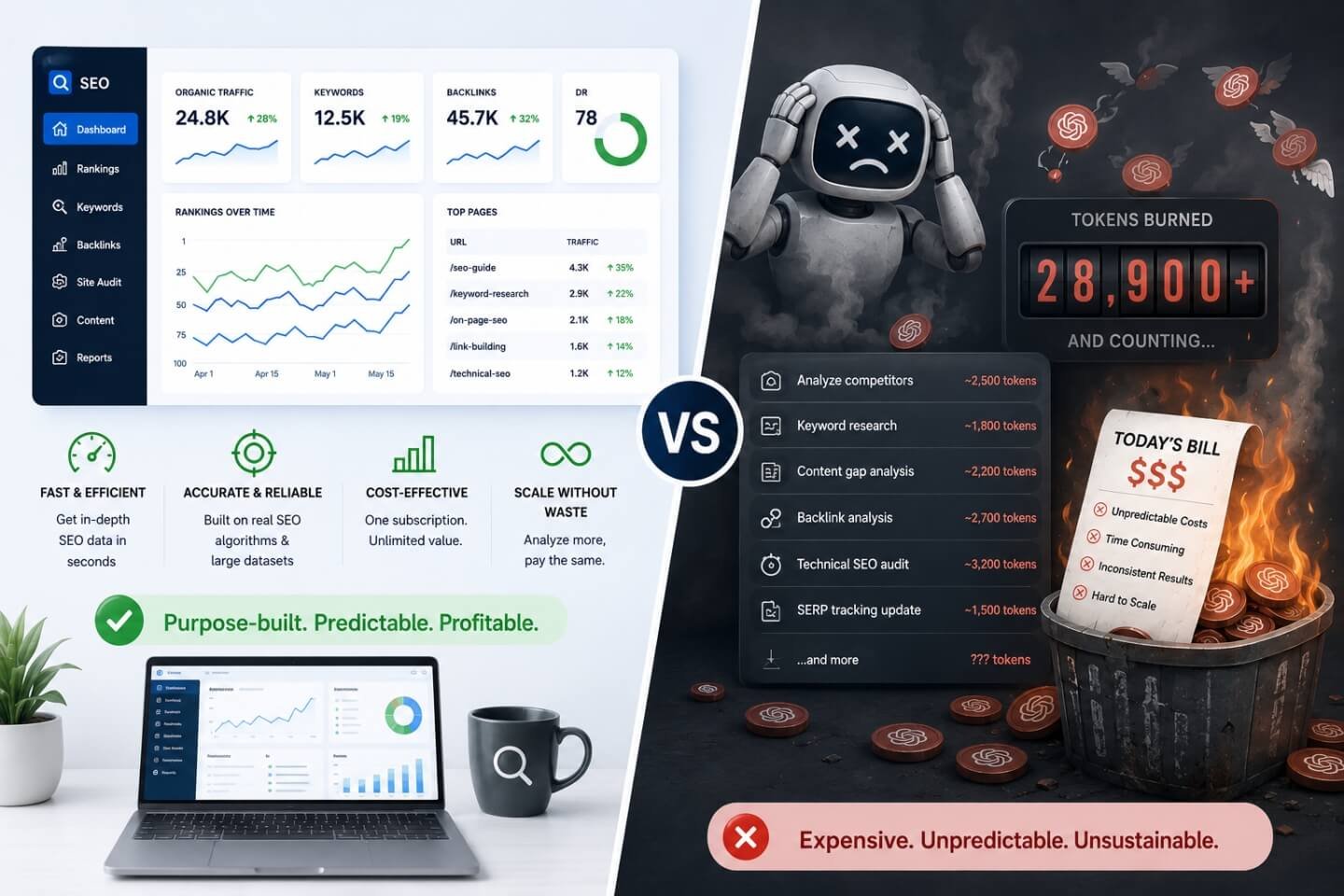
This is what “burning AI tokens” on SEO looks like in practice: not one clean answer, but a slow, expensive back-and-forth where you’re doing the validating, the fact-checking, and the assembling yourself. A dedicated SEO tool skips that entire loop. It’s built to hand you a finished, data-backed result in one pass — which is exactly the gap Herenkou.com is built to close.
What "Burning AI Tokens" on SEO Actually Looks Like
General-purpose AI chatbots are genuinely good at some parts of SEO work: brainstorming angles, drafting outlines, rewriting a clunky sentence. But ask one to do real research — keyword difficulty, live competitor rankings, current search volume — and the cracks show fast.
Here’s the typical loop:
- You ask for keyword ideas. You get a plausible-looking list. H3
- You ask for search volume. The model either declines (it doesn’t have live data) or gives you a number that sounds confident and isn’t verifiable. H3
- You ask it to check competitors. Without live browsing, it’s working from training data that may be months or years old. H3
- You catch an inconsistency, and you re-prompt to fix it. H3
- You repeat steps 2-4 for every keyword on your list.H3
Multiply that by every article you plan to write in a quarter, and you’re spending a meaningful chunk of your AI usage — and your own time — just trying to get a chatbot to approximate what a purpose-built research tool would hand you instantly.
Why General AI Chatbots Fall Short for SEO Specifically
This isn’t a knock on AI chatbots — they’re excellent at what they’re designed for: language generation and reasoning over the information they’re given. The problem is what SEO research actually requires, which is different.
No live search data.
A chatbot without active web access can’t tell you today’s search volume, today’s ranking positions, or today’s SERP features. It can describe the general shape of a topic; it can’t tell you what’s actually happening in Google’s index right now.
No persistent crawling of competitor pages.
Real competitive analysis means pulling the current top 10 results for a term and examining their structure, depth, and gaps. A general chatbot session doesn’t maintain a live connection to search results across many queries the way a dedicated research pipeline does.
Hallucination risk on specifics.
Ask for a statistic, a search volume figure, or a ranking difficulty score, and a language model can produce something that reads as authoritative but isn’t grounded in real data. You’re then responsible for verifying every number before you trust it — which erases much of the time savings you were chasing.
No memory between tasks.
Every new session (or every conversation that runs long enough to lose earlier context) means re-explaining your brand voice, your past keywords, your internal linking structure, and your competitors from scratch. A dedicated tool holds that context permanently.
Usage costs that scale with iteration, not with output.
This is the part that’s easy to underestimate. You’re not charged for getting the right answer — you’re charged (in tokens, in message limits, in subscription tier) for every attempt it takes to get there. A messy, iterative research process burns far more of your allowance than a single clean query to a tool built for the job.
The Real Cost of "Free" AI Research
It’s tempting to think of chatbot access as free or nearly free compared to a paid SEO subscription. In practice, the cost just moves somewhere else:
Token or message costs
on metered plans climb quickly once a task requires ten or fifteen exchanges instead of one.
Your own time
spent re-prompting, rephrasing, and fact-checking is the least visible cost and often the largest one.
Rate limits and context windows
cap how much you can actually push through a single session, which forces you to split research across multiple threads and lose continuity.
Verification overhead
— because you can’t fully trust unsourced numbers, you end up cross-checking them elsewhere anyway, which means you’re paying for two research processes instead of one.
None of this shows up as a single line item, which is exactly why it’s easy to miss. It shows up as a slower content pipeline and a higher cost per published article than the “free brainstorming” made it feel like at the start.
What a Dedicated SEO Tool Gives You That a Chatbot Can't
A tool built specifically for SEO research isn’t smarter than a general AI model — it’s structured differently, and that structure is the entire advantage:
Grounded data, not generated data.
Search volume, difficulty scores, and SERP composition come from real, current data sources rather than a model’s best guess.
One request, one complete answer.
Instead of building an answer across a dozen prompts, a dedicated research flow is designed to return everything you need — keyword, competitive landscape, gaps, outline — in a single pass.
Context that persists.
Your brand voice, keyword history, and internal link map stay attached to your account, not to a single chat session that eventually gets abandoned.
Predictable cost.
A subscription tied to output (briefs, articles, audits) is easier to budget against than a usage meter tied to how many attempts a task takes.
Where Herenkou Fits: Saving Tokens and Getting the Result You Actually Want
AI Keyword Intelligence
returns keyword opportunities scored against your actual domain authority, not a generic estimate you’d have to sanity-check yourself.The Content Optimization Engine
compares your draft against the top 20 ranking results and tells you specifically what’s missing — no back-and-forth needed to extract a usable answer.Automated Technical Audits
prioritize issues by traffic impact automatically, instead of you asking a chatbot to summarize a spreadsheet it can’t actually see.Rank Tracking & Reporting
keeps a persistent, updating record — something no chat session can maintain on its own.
Side by Side: Chatbot Iteration vs. a Dedicated SEO Tool
Task |
General AI Chatbot Approach |
Dedicated SEO Tool Approach |
| Keyword research | Multiple prompts, unverified volume estimates | One request, real search volume and difficulty |
| Competitor analysis | Limited to training data, no live SERP access | Live top-10 analysis, updated automatically |
| Content optimization | Manual back-and-forth to identify gaps | Direct comparison against current top-ranking pages |
| Technical audit | Can’t crawl your site or read real logs | Automated crawl with traffic-impact prioritization |
| Rank tracking | No persistent memory between sessions | Continuous tracking with alerts and reports |
| Cost model | Scales with attempts/iterations | Predictable, tied to output not retries |
When Each Approach Actually Makes Sense
None of this means AI chatbots have no place in an SEO workflow — they’re genuinely useful for early brainstorming, rewording a paragraph, or thinking through an angle before you commit to a topic. The distinction worth holding onto is what kind of task you’re handing off.
Use a general AI chatbot for open-ended thinking: “give me five angles on this topic,” “help me phrase this intro,” “what am I missing conceptually.” Use a dedicated SEO tool for anything that depends on real, current data: search volume, competitor rankings, technical site health, or ongoing tracking. Trying to make a chatbot do the second category’s job is where the token-burning cycle starts — not because the model is bad at reasoning, but because it’s being asked to substitute for data it was never given access to in the first place.
A Quick Example: Ten Articles a Month
Picture a content team publishing ten articles a month, each needing a primary keyword, a competitive landscape check, and an outline before writing starts.
Doing that research through a general AI chatbot typically means five to ten prompts per article just to land on a keyword and rough outline you’re willing to trust — and that’s before verifying any of the numbers elsewhere. Across ten articles, that’s fifty to a hundred exchanges spent on research alone, plus the separate time spent cross-checking search volume and difficulty in another tool because the chatbot couldn’t be fully trusted on its own.
Running the same research through a tool built to return validated data in one request collapses that into ten single requests — one per article — with the keyword, competitive landscape, and outline arriving together, already checked against real data. The time difference compounds fast once you’re publishing consistently rather than writing one piece as an experiment.
Frequently Asked Questions
Can ChatGPT replace a dedicated SEO tool?
Why does using AI chatbots for SEO end up costing more than expected?
Is it ever a bad idea to use AI chatbots for SEO at all?
Does Herenkou use AI, or is it purely data-driven?
How much time does a dedicated SEO tool actually save compared to chatbot-based research?
If your current SEO workflow involves re-prompting a chatbot until the numbers feel right, that friction is a signal, not a normal cost of doing business. A research brief built on real data gets you to a usable answer in one pass instead of ten.
Check out how the full workflow works or compare plans and pricing to see which tier fits your team’s content volume.