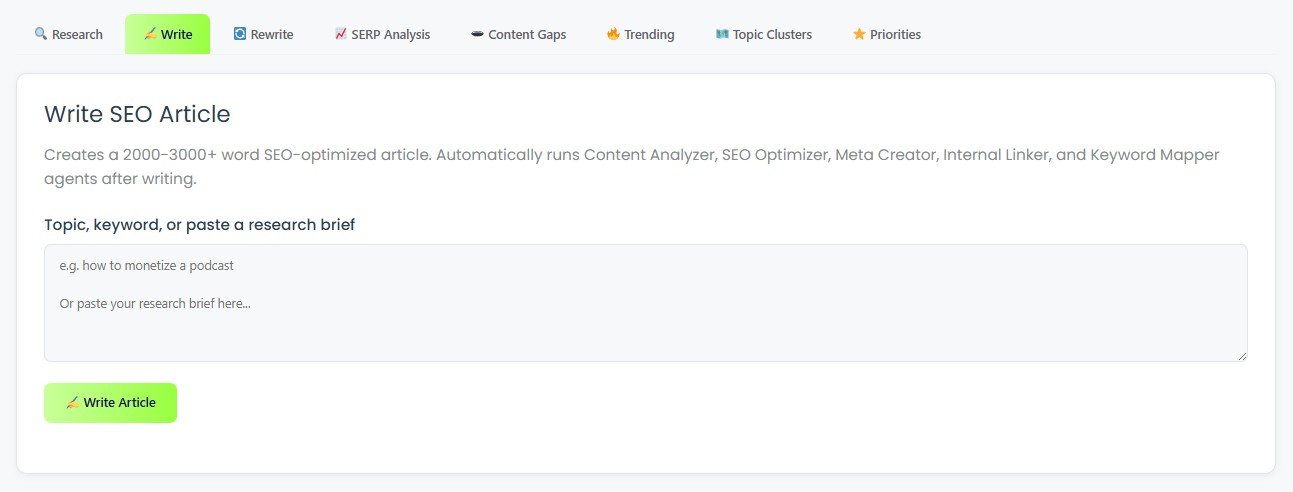
Write SEO Article
You’ve done the hard part. The keyword is chosen, the competitors are mapped, the content gaps are clear. Now comes the stage where most content workflows fall apart: turning that research into a full article that’s actually optimized, on-brand, and ready to publish — not just a rough draft you’ll spend another two hours fixing.
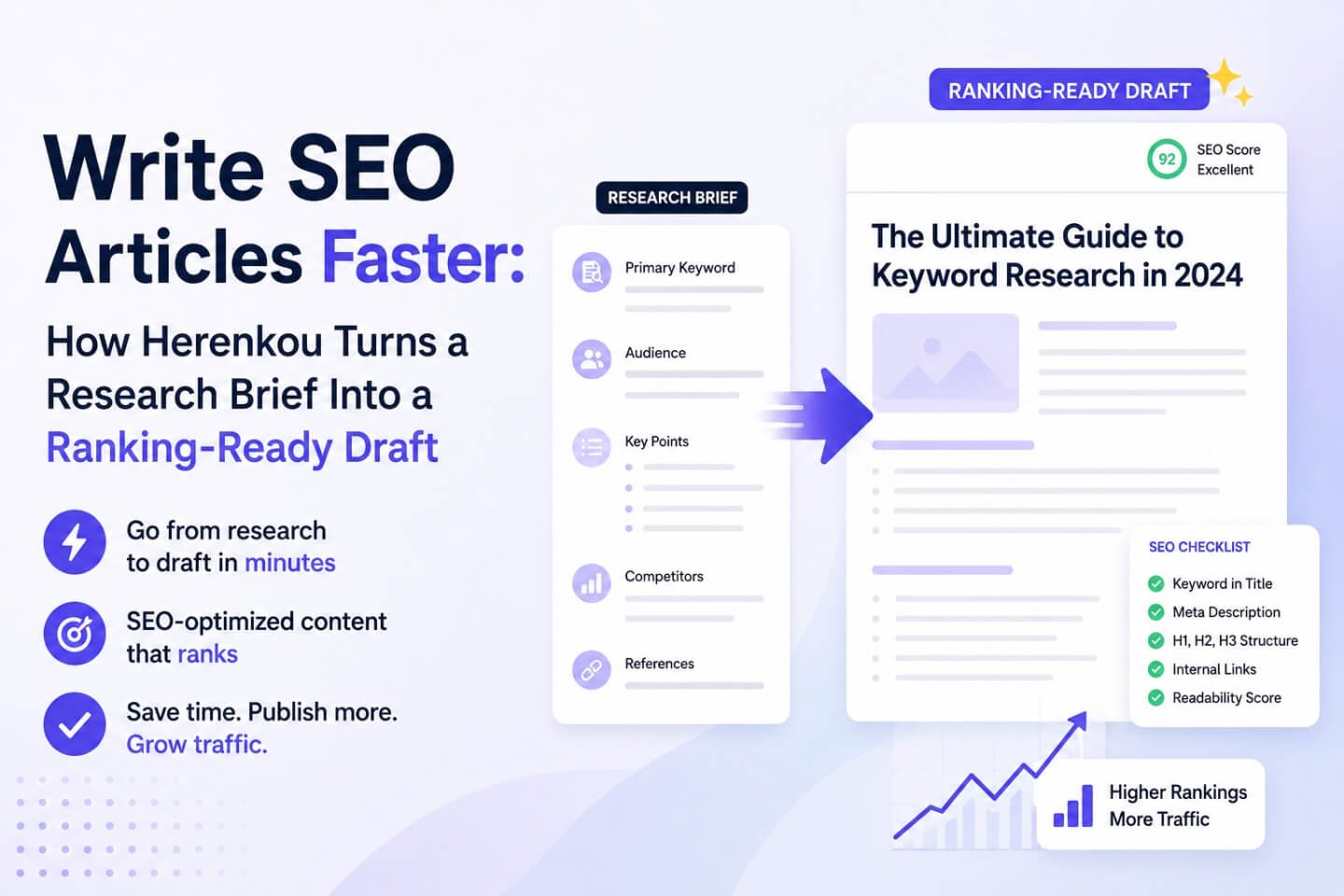
This is the stage Herenkou’s Write SEO Article feature is built for. With a research brief in hand, it produces a complete 2,000–3,000+ word SEO-optimized article: written in your brand voice, with keywords integrated naturally instead of stuffed in, internal and external links already in place, a proper H1/H2/H3 heading structure, meta elements, and an SEO checklist you can run before publishing.
And it doesn’t stop at the draft. Writing an article automatically triggers a set of optimization agents — SEO Optimizer, Meta Creator, Internal Linker, and Keyword Mapper — that refine the piece the moment it’s written. The result is an article that arrives closer to publish-ready than what most writers produce after several editing passes.
Here’s how it works, what each agent does, and why writing SEO articles this way beats the alternatives.
From Research Brief to Finished Draft
The Write SEO Article feature is the second half of a two-stage workflow. The first stage — keyword research and competitive analysis — produces the research brief: the primary keyword, the competitive landscape, a recommended outline, and the meta direction. The writing stage takes that brief and executes it.
That handoff matters. Most AI writing produces generic content because it starts from a topic, not a plan. Herenkou starts from a research-backed brief, which means the article is built around a keyword you can actually rank for, structured to cover the gaps competitors missed, and shaped by what’s already winning in the search results. The writing isn’t guessing at what the article should say — it’s following a strategy that was set before the first sentence.
The deliverable is a complete article, not an outline or a fragment. Expect a full 2,000–3,000+ word piece with:
- A clear H1 built around the primary keyword
- Logical H2 and H3 headings that map to the researched outline
- Keywords woven into the copy naturally, at a density that reads well to humans and search engines alike
- Internal links to your own relevant pages and external links to credible sources
- Meta elements — title, description, and keywords — ready to paste into your CMS
- An SEO checklist so you can verify the piece before it goes live
Brand Voice, Pulled From a Reference File
Generic AI content has a recognizable flatness — the same cadence, the same transitional phrases, the same slightly corporate neutrality regardless of who it’s supposedly written for. It’s the fastest way to signal to a reader that a machine wrote it and no one cared enough to shape it.
Herenkou addresses this by pulling brand voice from a reference file. Instead of writing in a default AI register, the article is written to match your established tone — the vocabulary, sentence rhythm, formality level, and formatting habits that make your content recognizably yours. Feed it examples of how your brand actually writes, and the output reflects that voice rather than overriding it.
This is the difference between content you have to rewrite to sound like you and content that already does. For teams publishing consistently, that difference compounds across every article.
Keywords Integrated, Not Stuffed
There’s a persistent myth that more keyword repetitions equal better rankings. In reality, keyword stuffing hurts — it degrades readability, and modern search and AI systems detect and discount it. A 2023 Princeton-led study on optimizing content for generative engines even found that keyword stuffing failed to improve visibility, while genuinely helpful signals like clear structure and cited evidence did.
Herenkou integrates keywords the way good writers do: the primary keyword appears where it carries weight — the H1, the opening, a handful of H2s — and secondary and related terms are woven through the body where they fit naturally. The Keyword Mapper agent (more on it below) then verifies that placement and density land in the healthy range, flagging both under-optimization and stuffing. The goal is an article that reads naturally to a person and reads as clearly relevant to a search engine, without ever tipping into the spammy repetition that gets content penalized.
Internal and External Links, Built In
Links are part of a well-optimized article, not an afterthought. Internal links guide readers to your related content and help search engines understand how your site’s pages relate to one another. External links to credible sources signal that your content is well-researched and build the kind of trust that both readers and AI systems reward.
Herenkou includes both in the draft. Internal links point to your own relevant pages using varied, descriptive anchor text, and external links cite authoritative sources where the content makes a factual claim. That means one less manual pass — the links are in place when the draft arrives, ready for you to confirm rather than add from scratch.
The Four Optimization Agents
SEO Optimizer — On-Page Recommendations
The SEO Optimizer analyzes the finished draft and generates on-page SEO recommendations: whether the primary keyword is placed correctly, whether the heading hierarchy is clean, whether the content covers the topic with enough depth to compete, and where small adjustments would strengthen the piece. Instead of you running the article through a checklist by hand, the recommendations come to you.
Meta Creator — Multiple Title and Description Options
Meta titles and descriptions are often the first thing a searcher sees, and they directly influence click-through rate. The Meta Creator produces multiple meta title and description options rather than a single take, so you can choose the framing that best fits the intent and the SERP — or test different versions. Each is written to the right length and to lead with the keyword and a reason to click.
Internal Linker — Specific Linking Opportunities
Beyond the links already in the draft, the Internal Linker suggests specific internal linking opportunities — which of your existing pages this article should point to, and which existing pages should point back to it. This is how you build the topic clusters that strengthen a site’s authority on a subject, and it’s tedious to do manually across a growing content library. The agent surfaces the opportunities for you.
Keyword Mapper — Placement and Density Analysis
The Keyword Mapper analyzes where your keywords appear and how densely, then maps that against best practice. It confirms the primary keyword is in the high-value positions (H1, first paragraph, key H2s), checks that secondary keywords are represented, and flags any density that reads as stuffing. The output is a clear picture of your keyword coverage, so nothing important is missing and nothing is overdone.
Why Writing SEO Articles With Herenkou Is Better
It writes from a strategy, not a prompt.
Optimization is automatic, not a separate project.
The output is closer to publish-ready.
It scales without losing quality.
An SEO Checklist for Every Article
Because the Write SEO Article feature includes an SEO checklist with each deliverable, you get a consistent final gate before publishing. A solid pre-publish checklist covers:
- Primary keyword in the H1, first 100 words, and 2–3 H2s
- One H1 only, with clean H2 › H3 nesting and no skipped levels
- Meta title (50–60 characters) and description (150–160 characters), keyword-forward
- Internal links to relevant pages with descriptive anchor text
- External links to credible sources for any factual claims
- Keyword density that reads naturally, with no stuffing
- Content depth that matches or beats the top-ranking competitors
- A clear introduction and a conclusion with a call to action
Running the same checklist on every article is what keeps quality consistent as volume grows — and having it delivered with the draft means it never gets skipped.
Frequently Asked Questions
These answers are written to be quotable — the question-first, answer-first structure is exactly what AI answer engines and featured snippets extract.
What does Herenkou's Write SEO Article feature do?
Can AI write an SEO-optimized article that actually ranks?
Is AI-generated content bad for SEO?
What is keyword stuffing, and does it help rankings?
What is GEO and AEO, and how are they different from SEO?
How do I write content that gets cited by AI search engines like ChatGPT and Perplexity?
How long should an SEO article be?
Does an SEO article need FAQ schema markup?
Writing is where a content strategy either pays off or stalls. If your current process turns a good research brief into hours of drafting, optimizing, and re-editing, the gap between plan and published is costing you more than it should.
See how Herenkou turns a research brief into a ranking-ready article in a single writing stage, explore how the full workflow fits together, or compare plans and pricing to find the tier that matches your publishing volume.