
Scrub AI Pattern
Readers can tell. Even when they can’t explain why, something about an obviously machine-written copy makes them trust it less, engage with it less, and leave sooner. The tells are subtle but consistent: em-dashes in every other sentence, filler phrases that pad without adding meaning, and a rhythm so even it starts to feel mechanical. None of these ruin a sentence on its own. Stacked across a whole article, they quietly announce that no one really wrote this.
That perception carries a cost. Trust drops, time-on-page falls, and search engines increasingly reward content that demonstrates genuine expertise and human care over text that reads as templated output.
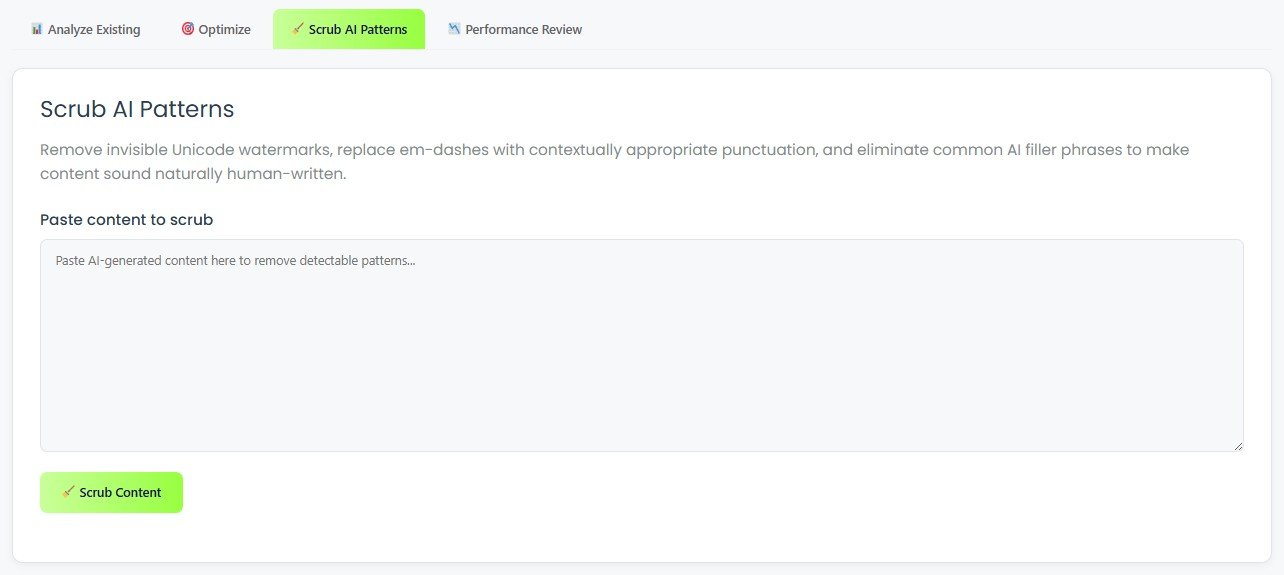
Herenkou’s Scrub AI Pattern feature exists to close that gap. It removes the telltale watermarks of AI writing so the final copy reads naturally and holds up to human review, without you having to hunt down every awkward tic by hand.
Below: what these AI patterns actually are, why they matter for SEO and for readers, and why scrubbing them through Herenkou beats doing it manually.
What "AI Patterns" Actually Are
Overused em-dashes.
AI writing leans hard on the em-dash as an all-purpose connector, dropping it into sentence after sentence where a comma, a period, or a simple restructure would read better. A single well-placed dash adds emphasis. A dozen per page reads like a verbal tic.
Generic filler phrases.
Certain constructions appear constantly in machine text and rarely in careful human writing. Openers like “in today’s fast-paced world,” hedges like “it’s important to note that,” and empty transitions that announce a point without making it. They add word count and subtract meaning.
Repetitive sentence rhythms.
Perhaps the deepest tell. AI often produces sentences of similar length and structure, one after another, with the same cadence and the same shape. Human writing varies. Short punches. Then a longer, winding sentence that takes its time and lets an idea breathe before landing. That variation is part of what makes prose feel alive, and its absence is part of what makes AI text feel flat.
Individually, any of these can appear in perfectly good human writing. The problem is the pattern: when all three cluster together across an article, they form a signature that readers register as artificial even when they can’t name it.Lorem ipsum dolor sit amet, consectetur adipiscing elit. Ut elit tellus, luctus nec ullamcorper mattis, pulvinar dapibus leo.
Why AI Patterns Hurt Your Content
The instinct might be to shrug this off as cosmetic. It isn’t. The costs are real and they compound.
Trust erodes.
When content reads as machine-generated, readers assume less care went into it, and they extend less credibility to what it says. For content meant to establish authority, that’s the opposite of the goal. A reader who senses a bot wrote your buying guide trusts the recommendation less.
Engagement drops.
Flat, mechanical prose is easy to stop reading. Higher bounce rates and lower time-on-page follow, and those behavioral signals can feed back into how search engines judge whether your page satisfied the visitor.
Search performance can suffer.
Search engines increasingly prize content that demonstrates real experience and expertise. Text that reads as generic AI output, thin on genuine insight and heavy on filler, runs against that grain. The issue was never that a machine helped write it; the issue is copy that reads as though no human cared enough to shape it.
AI answer engines are pickier than they look.
Even generative engines, the systems you might expect to favor machine-friendly text, reward clarity, natural language, and evidence over formulaic filler. Research into what gets cited by AI has found that keyword stuffing and hollow phrasing don’t help, while clear, well-sourced, naturally written content does. Scrubbing AI patterns serves both human readers and the machines.
What the Scrub AI Pattern Feature Does
Scrub AI Pattern is a cleanup stage applied to finished copy. It reviews the text for the signatures described above and rewrites them out, while leaving the substance intact. In practice, that means three kinds of work.
It thins out the em-dashes, keeping the ones that earn their place and converting the rest into cleaner punctuation or restructured sentences, so the article no longer leans on a single crutch for every pause.
It strips the filler, cutting the empty openers, redundant hedges, and hollow transitions that pad AI text, and tightening what remains so each sentence carries weight.
It varies the rhythm, breaking up the monotonous same-length, same-shape cadence by mixing short sentences with longer ones and changing how sentences begin, so the prose moves the way human writing moves.
The result is copy that reads naturally and passes human review. The meaning, the keywords, and the structure survive; what disappears is the machine accent. You get content a reader would take for careful human writing, because after the scrub, that’s effectively what it is.
Why Using Herenkou Is Better for SEO Content
You can scrub AI patterns by hand. Anyone with a good ear can catch an overused dash or a filler phrase and fix it. The catch is that doing it well, consistently, across every article you publish, is slow and easy to shortchange when deadlines press. Herenkou makes the cleanup systematic.
It knows what to look for.
It's consistent across everything you publish.
It preserves substance while fixing style.
A careless rewrite can strip the AI accent and gut the meaning along with it. The scrub is built to change how the copy reads without changing what it says, so your keywords, facts, and structure stay put.
It fits a complete workflow.
Scrubbing AI patterns is the finishing touch on a pipeline that already handled research, writing, optimization, and review. The polish is applied within the same system that produced the draft, not in a separate tool you have to paste into and out of.
Before and After: What a Scrub Looks Like
An example makes the difference concrete. Here is a paragraph carrying every common AI tell, followed by the same idea after a scrub.
Before: “In today’s fast-paced digital world, it’s important to note that content quality matters — engagement matters — and trust matters — more than ever before. When it comes to creating content, businesses need to understand that readers are savvy — they can tell when something feels off — and they will leave — quickly.”
Notice the pile-up: a generic opener, stacked hedges, an em-dash in nearly every clause, and two sentences with almost identical shape and length.
After: “Readers are savvy. They can tell when something feels off, and when it does, they leave fast. That makes content quality and trust worth more than ever, especially for businesses trying to earn a reader’s confidence rather than just fill a page.”
Same meaning, roughly the same length, none of the tells. The opener is gone, the hedges are cut, the dashes are down to none, and the rhythm now varies. That is the transformation the Scrub AI Pattern feature applies across a whole article, not just one paragraph.
A Human-Sounding Copy Checklist
The feature automates this, but here is the checklist it effectively runs, useful whether you are reviewing its output or self-editing a draft:
- Are em-dashes used sparingly, only where they add real emphasis?
- Have generic openers (“in today’s world,” “when it comes to”) been cut?
- Have empty hedges (“it’s important to note,” “it’s worth mentioning”) been removed?
- Do sentence lengths vary, with a mix of short and long?
- Do sentences start in different ways, rather than repeating the same structure?
- Does any paragraph read as padding rather than substance?
- Would a careful reader take this for human writing?
- Does the copy still contain the keywords, facts, and structure it needs after editing?
Frequently Asked Questions
These answers use the question-first, answer-first structure that AI answer engines and featured snippets tend to extract.
What does Herenkou's Scrub AI Pattern feature do?
Herenkou’s Scrub AI Pattern feature removes the telltale watermarks of AI-generated writing from finished copy. It thins out overused em-dashes, strips generic filler phrases, and varies repetitive sentence rhythms, so the final content reads naturally and passes human review. It changes how the copy reads without altering its meaning, keywords, or structure.
How can you tell if content was written by AI?
Common signs include heavy reliance on em-dashes, generic filler phrases like “in today’s fast-paced world,” repetitive sentence lengths and structures, and an overall even, mechanical rhythm. No single trait proves a machine wrote something, but when several appear together across an article, the text tends to read as artificial even to readers who can’t name why.
Does AI-generated content hurt SEO?
Not because it was AI-assisted, but because AI content is often generic, thin, or full of filler. Search engines reward content that shows genuine experience, expertise, and usefulness, and they don’t penalize a page simply for having AI help in its creation. The reliable path is to use AI for speed, then edit for substance and natural readability so the finished page earns trust from both readers and search engines.
Why does content that sounds like AI reduce reader trust?
Readers associate flat, formulaic, filler-heavy writing with low effort and low credibility. When copy reads as machine-generated, people assume less care went into it and extend less trust to its claims, which lowers engagement and can raise bounce rates. Writing that reads naturally signals that a person shaped the content, which supports the trust that authority-building content depends on.
What is GEO and AEO, and does removing AI patterns help with them?
GEO (generative engine optimization) is optimizing content to be cited by AI engines like ChatGPT, Perplexity, Gemini, and Google’s AI Overviews. AEO (answer engine optimization) is optimizing content to be extracted as a direct answer in snippets and AI answer boxes. Removing AI patterns helps both, because these engines favor clear, natural, well-sourced writing over formulaic filler. Research on AI citation has found that hollow phrasing and keyword stuffing don’t improve visibility, while genuinely clear content does.
Will editing out AI patterns change my keywords or SEO?
No, when it’s done properly. A good scrub changes style, not substance: it improves punctuation, cuts filler, and varies rhythm while leaving your keywords, facts, headings, and structure intact. Herenkou’s Scrub AI Pattern feature is built specifically to preserve the SEO elements of a piece while making the prose read naturally, so cleaning up the writing doesn’t cost you optimization.
Is it okay to use AI to write SEO content at all?
Yes, provided the output is edited to be accurate, substantive, and naturally written. Search engines judge content on quality and helpfulness rather than on whether AI assisted with it. The problems arise only when AI content is published raw: thin, generic, or riddled with machine tells. Pairing AI-assisted drafting with genuine editing and a pass to remove AI patterns is a sound, widely used approach.
How do I make AI writing sound more human?
Vary your sentence lengths and openings, cut filler phrases and empty transitions, use em-dashes sparingly, and add specific, concrete detail in place of generic statements. Read the text aloud to catch mechanical rhythm. A dedicated tool like Herenkou’s Scrub AI Pattern feature automates this by targeting the known signatures of AI writing, producing copy that reads as though a person wrote and edited it carefully.
AI-assisted content only works if it doesn’t read like it. The speed is worth little if the finished copy costs you the reader’s trust the moment they sense a machine behind it. A final scrub keeps the speed and returns the human voice.
See how Herenkou removes AI patterns as the finishing touch on a complete content workflow, explore how the full process fits together, or compare plans and pricing to find the tier that matches your publishing needs.